The 2016 Election: Third Party?

The patriot motto.
Waking up to the news this morning. Sheesh.
Well, I’ve been eligible to vote in the presidential elections since 1988. And, I’ve voted:
1988: Libertarian
1992: Libertarian
1996: Republican
2000: Libertarian
2004: Libertarian
2008: Libertarian
2012: Republican
My votes in 1996 and 2012 are two of the biggest regrets in my life.
So, if last night’s results are any indication of where this election is headed, I will be voting Libertarian in 2016. I’m not a member of the Libertarian party. Instead, I’ve been registered Republican since 1986. Still, I’m keeping my options open for this election year.
I do wish Gary Johnson would adopt Ron Paul’s stance on issues of life and conception.
Voluntary Associations and America
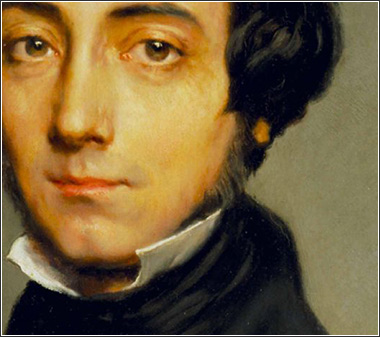
Alexis De Tocqueville
Voluntary associations have played a vital and pervasive role in the development of the American frontier and West, as well as for the United States as a whole. In an oft-quoted passage, Alexis de Tocqueville wrote in Democracy in America:
Americans of all ages, all stations in life, and all types of disposition are forever forming associations. There are not only commercial and industrial associations in which all take part, but other of a thousand different types—religious, moral, serious, futile, very general and very limited, immensely large and very minute. Americans combine to give fêtes, found seminaries, build churches, distribute books, and send missionaries to the antipodes. Hospitals, prisons, and schools take shape in that way. Finally, if they want to proclaim a truth or propagate some feeling by the encouragement of a great example, they form an association. In every case, as the head of any new undertaking, where in France you would find the government or in England some territorial magnate, in the United States you are sure to find an association.[i]
Despite the obvious significance of voluntary associations to American culture, an examination of the historical literature reveals that only a few scholars, often working in temporal concentrations separated by decades, have taken any deep interest in their importance for U.S. history as a whole; and only rarely has that interest manifested itself in the histories of the American West. The interest began, of course, with Tocqueville who probably was inspired by the Anglo-Irish political philosopher Edmund Burke, and can also be found in the writings of Frederick Jackson Turner, the founder of frontier history.[ii] A new concentration, beginning in the 1950s, after the revived interest in Tocqueville in the 1940s, originates with historical sociologist Robert Nisbet (himself a self-avowed Tocquevillian) and historians Daniel Boorstin, Oscar and Mary Handlin, and Rowland Berthoff in the 1960s and 1970s.[iii] A revival—its strength and longevity remains to be seen—began anew in 1995 with the publication of Robert D. Putnam’s whimsically titled article “Bowling Alone: America’s Declining Social Capital” and Robert Wiebe’s book Self-Rule. Anne Firor Scott’s 1991 Natural Allies has undoubtedly added to the revival as well. Of the literature that does exist, most of it is seemingly sympathetic.
As Robert Nisbet persuasively argues, Tocqueville was a French Burkean who viewed community and its interaction with the individual as organic. For Tocqueville, this organic or natural quality of American voluntary associations allowed them to promote both equality and liberty. Contrasting the hierarchy of the aristocratic society, the French political observer argued that the rampant individualism of American society made everyone equally weak, thus forcing them “to help each other voluntarily” to survive. Just as important, people who had “lost the power of carrying through great enterprises by themselves, without the faculty of doing them together, would soon fall back into barbarism.” According to his logic, a stable American individualism both precipitates and depends upon voluntary unification.
As for liberty, Tocqueville contended, the natural formation of voluntary associations allows Americans to do for themselves what governments in Europe might do for their citizenry. America, in this respect, was superior to Europe. Governments and bureaucracies, Tocqueville claimed, are neither organic nor subtle. They are unable to make nuanced or delicate decisions, as can voluntary associations in which “[f]eelings and ideas are renewed, the heart enlarged.” Governments, try though they might, are incapable of changing the true morals or being of the individual. “Once [government] leaves the sphere of politics to launch out on this new track,” argued Tocqueville, “it will, even without intending this, exercise an intolerable tyranny.” Worse, the control of societal change and growth is a zero-sum game. If the citizenry controls the power to make decisions, the government must be necessarily and proportionately smaller. In a “vicious cycle,” the reverse is also true. “The more government takes the place of associations,” Tocqueville wrote, “the more will individuals lose the idea of forming associations and need the government to come to their help.”[iv]
Frederick Jackson Turner gave a deferential nod to Tocqueville and addressed the importance of voluntary associations in his 1918 speech before the State Historical Society of Minnesota entitled “Middle Western Pioneer Democracy.” The natural ability to form spontaneous associations without the aid or interference of government, Turner claimed, is an inherent American trait. In the Old World, such things could only be accomplished by government compulsion and domination. The “backwoods democrats” of America “hated the doctrine of autocracy even before it gained a name.” Updating Jefferson’s concept of the natural aristocracy, Turner argued that spontaneity, competition, and voluntary action allow “the abler man . . . [to] reveal himself, and show them the way.” This absence of government also permitted individuals to feel confident, optimistic, and enthusiastic about themselves and their society.[v]
After nearly three decades of academic neglect, interest in Tocqueville, community, and voluntary associations arose in the thirty years following World War II. In 1953, Nisbet published his first book, The Quest for Community: A Study in the Ethics of Order and Freedom, a sophisticated work in which he argues that organically-evolved communities, associations (not always voluntary), and tight social bonds are essential to ward off both licentious individualism and a pernicious Leviathan, the mammoth and intrusive state. After surveying the debates in western civilization from the Greeks through the Scholastics through the present, Nisbet concludes that the West is caught between
two worlds of allegiance and association. On the one hand, and partly behind us, is the historic world in which loyalties to family, church, profession, local community, and interest association exert, however ineffectually, persuasion and guidance. On the other is the world of values identical with the absolute political community—the community in which all symbolism, allegiance, responsibility, and sense of purpose have become indistinguishable from the operation of centralized political power.[vi]
Organic, intermediary institutions—not always voluntary—offer alternative authority to the federal government. Ironically, the conservative Nisbet significantly influenced the social thought and action of numerous leftists in the 1960s.[vii]
____
[i] Tocqueville, Democracy in America, 513.
[ii] On Burke’s profound influence on Tocqueville, see Robert Nisbet, Conservatism: Dream and Reality (Minneapolis: University of Minnesota, 1986). For Turner, see his “Middle Western Pioneer Democracy” in Rereading Frederick Jackson Turner: ‘The Significance of the Frontier in American History’ and Other Essays, ed. John Mack Faragher (New York: Henry Holt, 1994), 159-80.
[iii] On the renewed interest in Tocqueville, see John Higham, History: Professional Scholarship in America, rev. ed. (Baltimore: Johns Hopkins University Press, 1989), 221. Regarding Tocqueville’s influence on Robert Nisbet, see J. David Hoeveler, Jr., Watch on the Right: Conservative Intellectuals in the Reagan Era (Madison: University of Wisconsin Press, 1991), chapter 7. Looking back on the time he first read Democracy in America, Nisbet wrote, “I am not likely myself to forget soon the thrill. . . . Of a sudden, a great deal about modern Western history an society took on new meaning for me” (Hoeveler, 181). The debate over community—the much larger issue encompassing voluntary associations—is simply too big to treat here with any integrity.
[iv] Tocqueville, Democracy in America, 514-6.
[v] Turner, “Middle Western Pioneer Democracy,” 166-8.
[vi] Robert Nisbet, The Quest for Community: A Study in the Ethics of Order and Freedom (New York: Oxford University Press, 1953), 280. For a more recent work, see Robert Nisbet, The Present Age: Progress and Anarchy in Modern America (New York: Harper & Row, 1988), chapters 2 and 3.
[vii] Hoeveler, 182.
Apple vs. the FBI
Amen, Apple. Thank you. Beautifully stated.

February 16, 2016
A Message to Our Customers
The United States government has demanded that Apple take an unprecedented step which threatens the security of our customers. We oppose this order, which has implications far beyond the legal case at hand.
This moment calls for public discussion, and we want our customers and people around the country to understand what is at stake.
The Need for Encryption
Smartphones, led by iPhone, have become an essential part of our lives. People use them to store an incredible amount of personal information, from our private conversations to our photos, our music, our notes, our calendars and contacts, our financial information and health data, even where we have been and where we are going.
All that information needs to be protected from hackers and criminals who want to access it, steal it, and use it without our knowledge or permission. Customers expect Apple and other technology companies to do everything in our power to protect their personal information, and at Apple we are deeply committed to safeguarding their data.
Compromising the security of our personal information can ultimately put our personal safety at risk. That is why encryption has become so important to all of us.
For many years, we have used encryption to protect our customers’ personal data because we believe it’s the only way to keep their information safe. We have even put that data out of our own reach, because we believe the contents of your iPhone are none of our business.
The San Bernardino Case
We were shocked and outraged by the deadly act of terrorism in San Bernardino last December. We mourn the loss of life and want justice for all those whose lives were affected. The FBI asked us for help in the days following the attack, and we have worked hard to support the government’s efforts to solve this horrible crime. We have no sympathy for terrorists.
When the FBI has requested data that’s in our possession, we have provided it. Apple complies with valid subpoenas and search warrants, as we have in the San Bernardino case. We have also made Apple engineers available to advise the FBI, and we’ve offered our best ideas on a number of investigative options at their disposal.
We have great respect for the professionals at the FBI, and we believe their intentions are good. Up to this point, we have done everything that is both within our power and within the law to help them. But now the U.S. government has asked us for something we simply do not have, and something we consider too dangerous to create. They have asked us to build a backdoor to the iPhone.
Specifically, the FBI wants us to make a new version of the iPhone operating system, circumventing several important security features, and install it on an iPhone recovered during the investigation. In the wrong hands, this software — which does not exist today — would have the potential to unlock any iPhone in someone’s physical possession.
The FBI may use different words to describe this tool, but make no mistake: Building a version of iOS that bypasses security in this way would undeniably create a backdoor. And while the government may argue that its use would be limited to this case, there is no way to guarantee such control.
The Threat to Data Security
Some would argue that building a backdoor for just one iPhone is a simple, clean-cut solution. But it ignores both the basics of digital security and the significance of what the government is demanding in this case.
In today’s digital world, the “key” to an encrypted system is a piece of information that unlocks the data, and it is only as secure as the protections around it. Once the information is known, or a way to bypass the code is revealed, the encryption can be defeated by anyone with that knowledge.
The government suggests this tool could only be used once, on one phone. But that’s simply not true. Once created, the technique could be used over and over again, on any number of devices. In the physical world, it would be the equivalent of a master key, capable of opening hundreds of millions of locks — from restaurants and banks to stores and homes. No reasonable person would find that acceptable.
The government is asking Apple to hack our own users and undermine decades of security advancements that protect our customers — including tens of millions of American citizens — from sophisticated hackers and cybercriminals. The same engineers who built strong encryption into the iPhone to protect our users would, ironically, be ordered to weaken those protections and make our users less safe.
We can find no precedent for an American company being forced to expose its customers to a greater risk of attack. For years, cryptologists and national security experts have been warning against weakening encryption. Doing so would hurt only the well-meaning and law-abiding citizens who rely on companies like Apple to protect their data. Criminals and bad actors will still encrypt, using tools that are readily available to them.
A Dangerous Precedent
Rather than asking for legislative action through Congress, the FBI is proposing an unprecedented use of the All Writs Act of 1789 to justify an expansion of its authority.
The government would have us remove security features and add new capabilities to the operating system, allowing a passcode to be input electronically. This would make it easier to unlock an iPhone by “brute force,” trying thousands or millions of combinations with the speed of a modern computer.
The implications of the government’s demands are chilling. If the government can use the All Writs Act to make it easier to unlock your iPhone, it would have the power to reach into anyone’s device to capture their data. The government could extend this breach of privacy and demand that Apple build surveillance software to intercept your messages, access your health records or financial data, track your location, or even access your phone’s microphone or camera without your knowledge.
Opposing this order is not something we take lightly. We feel we must speak up in the face of what we see as an overreach by the U.S. government.
We are challenging the FBI’s demands with the deepest respect for American democracy and a love of our country. We believe it would be in the best interest of everyone to step back and consider the implications.
While we believe the FBI’s intentions are good, it would be wrong for the government to force us to build a backdoor into our products. And ultimately, we fear that this demand would undermine the very freedoms and liberty our government is meant to protect.
Tim Cook
Eric Voegelin on Gnosticism
 This morning, over at The Imaginative Conservative, Eric Voegelin’s Gnosticism.
Though we associate Gnosticism with early Christianity, especially with the warnings against the “anti-Christ” in the writings of St. John the Beloved, Gnosticism actually emerged in the Near East and Asian Subcontinent roughly 600 years before Jesus lived. When Jesus lived and died, however, the Gnostics saw him as the perfect vehicle to promote their own vision of the world. They did not necessarily love Jesus; they simply saw him as a popular figure whose memory and image could be manipulated for their own purposes.
As Voegelin rightly notes, for the Gnostic, man will always be an alien in this world, and he must always seek a way out.
http://www.theimaginativeconservative.org/2016/02/eric-voegelins-gnosticism-2.html
Goldwater at Notre Dame, Feb. 1962
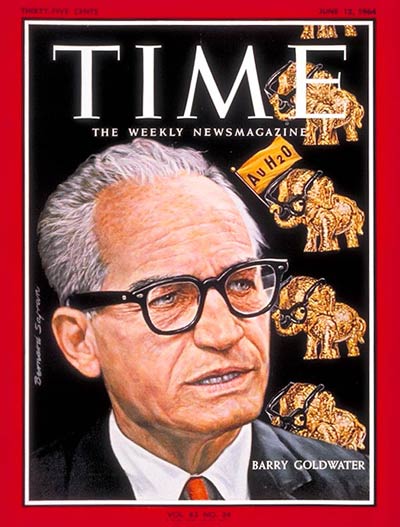
Goldwater, Time Magazine, 1964
The following is a link to Barry Goldwater’s speech—one of his best—given at Notre Dame, February 1962.
Goldwater’s ally and friend, Russell Kirk, actually wrote the speech for the Arizona senator.
By all accounts, the University of Notre Dame community received the talk well.
And, well they should’ve! It’s a great statement about the essence and meaning an purpose of conservatism.
http://www.theimaginativeconservative.org/2012/11/the-best-presidential-campaign-speech.html
Timeline, American Crises, 1763-1774
“Crises Points, Leading to Revolution, 1763-1774”-by Brad Birzer. The following comes from a number of sources over twenty five years of reading and teaching founding. Please let me know if you see any errors. Much appreciated!
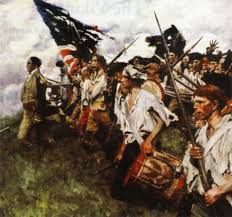 Opening to Crisis, 1763-1765
- Bureaucracy tried to enforce the Sugar taxes. Taxed molasses and sugar at half the rate of the Navigation Acts. But, in reality, that tax had never been enforced! So, this tax was huge to the settlers. Hit New England hardest.
- In 1765, Parliament passed the Stamp Act. Every single legal transaction had to have a stamp on it(meaning it had been taxed). Pervasive and intensely bureaucratic.
- In 1765, Parliament also passed the Quartering Act (another tax), forcing average citizens to give up their homes to soldiers who needed housing. Especially hit New York, the headquarters of British forces in America.
American Responses, 1765
- Pamphlets
- Protests. mass meetings, parades, bonfires. Groups began to call themselves the Sons of Liberty. Would meet under “Liberty Trees” and erect liberty poles, often with effigies hanging from them. Sons of Liberty led a mob against the Massachusetts home of Lt. Governor Thomas Hutchinson. Literally tore the house down and drank his wine.
- Under the leadership of Patrick Henry, the Virginia House of Burgesses passed a series of Resolves against the Stamp Act. Henry even spoke of regicide, the assassination of King George III. When told that was treason, he replied “If this be treason, make the most of it.”
- John Adams is the first American to call for Independence.
British response to American Protests
July 1765, Rockingham, a pro-American Prime Minister, elected Prime Minister. Rockingham Whigs chose Edmund Burke as their main advisor.
- Repealed the Stamp Act in 1766 and reduced the Sugar Tax to one penny (less than the cost of a bribe)
- But to pacify the opposition, Parliament passed the Declaratory Act–stated that Parliament had control of the colonies in all matters.
New Parliament, 1767
In the spring and early summer of 1767, the Parliament passed the Townsend Acts which
- Suspended the New York Assembly for refusing to supply homes and assistance to British Troops
- Placed a tax on colonial imports—glass, lead, paints, paper, and tea
- Set up an office in Boston to monitor smuggling
Boston Massacre, 1770
On March 5, 1770, a crowd gathered and began throwing snowballs at the soldiers, protesting the standing army as tyranny. Soldiers opened fire on the crowd. Americans began calling the army the “corrupt arm of British despotism.” The soldier were tried, defended by John Adams. All were acquitted but two who received light punishments.
1772
- Off of Rhode Island, a British ship looking for smugglers (the Gaspee) ran aground. Colonists stormed the ship, kicked the sailors off, and burned it. Parliament established an independent commission to investigate–had power to try out of normal courts. Colonists viewed this as a violation of rights.
- In November 1772, Sam Adams formed the first of the Committees of Correspondence. They soon developed throughout the colonies—information distribution; relay stations
1773
In Spring of 1773, the East India Company was experiencing a real drop in business. Had 17 million pounds of tea rotting in British warehouses. Parliament granted the company a monopoly on tea—even allowed to sell it cheaper than the colonists could get it from the Dutch. Thought the colonists were motivated by material considerations. All the colonists could see was the monopoly granted to the East Indian Co.
- Under the leadership of Sam Adams, a group of men dressed as Mohawk Indians boarded a British ship and dumped its tea into the harbor. Meanwhile, large crowds on the docks cheered.
Coercive Acts, March 1774
- Closed the Boston Port
- Set up martial law under the Governor
- Close the courts in trials of British
- Soldiers could lodge anywhere
Quebec Act, Summer 1774
- First Continental Congress called, September 1774
- Independence from Parliament declared, September 1774
James Otis, 1764
Founding father, James Otis.
But let the origin of government be placed where it may, the end of it is manifestly the good of the whole. Salus populi supreme lex esto, is of the law of nature, and part of that grand charter given the human race, (tho’ too many of them are afraid to assert it,) by the only monarch in the universe, who has a clear and indisputable right to absolute power; because he is the only One who is omniscient as well as omnipotent.

To read all of Otis’s speech (and you should!), please go here: http://teachingamericanhistory.org/library/document/the-rights-of-the-british-colonies-asserted-and-proved/
American Revolutionary Timeline, 1774-1784
Revolution Timeline–Created by Brad Birzer
Pretty obvious!
I’ve created the following–for what it’s worth–from a variety of sources beginning from own college days when I had the privilege of studying the American Revolution with the profoundly wonderful Gregory Dowd (a man of equal parts brilliance, scholarship, and personality). And, I’ve added to it as I’ve had the privilege to teach founding at Hillsdale College and at the University of Colorado-Boulder.
Feel free to use it (students, teachers, interested parties). If you see errors in it, please let me know!
Thoughts of American Independence, 1633-1755

Colonial home. Built for a wealthy and expansive people.
From the moment Englishman began to settle America, ideas here as well as in England began to drift toward some form of independence. Some quotes taken from an excellent 1974 article:
American Birthrates, Colonial-1870

Nugent’s 1981 masterpiece on American demographic history
While an undergraduate at the University of Notre Dame (B.A., 1990), I had the immense pleasure of working with Professor Walter T.K. Nugent, a scholar of remarkable talents. Not only did he serve as one of my main professors, but I had also a full year as his research assistant. I admired him immensely and still do. One of his many expertise was the demographic history of the United States. As he taught in the 1980s, the world had never seen a birth rate equal to the American birthrate (for whites, but blacks were not far behind), 1720-1870. It is nothing short of astounding.
Here are a few quotes to illustrate:
“Fertility was enormously high as long as the young couple could form their own household on their own land. Females reached menarche at about age fifteen in 1800 and perhaps a few months earlier in 1850. If a woman married soon after that, as many did, the ultimate size of her family could be prodigious. The American and Canadian census manuscripts are crowded with cases of women marrying at sixteen or seventeen and producing a child every eighteen to twenty-four months–about the biological maximum because of breast-feeding and pregnancy intervals–until reaching menopause in their mid-forties. The average number of children born per woman in her lifetime, as of 1790, was almost eight. . . . Newly married women could look forward to twenty or even thirty fertile years.” [Nugent, STRUCTURES, 57-58]
Rachel Gough on Parenting
When my daughter was born, my heart shattered with love. . .
 A beautiful lightning essay by my former student and always-friend, Rachel Gough. Enjoy.
http://kindredmag.com/2016/02/03/parenting-is-an-extreme-sport/
Larry Reed on Edmund Burke
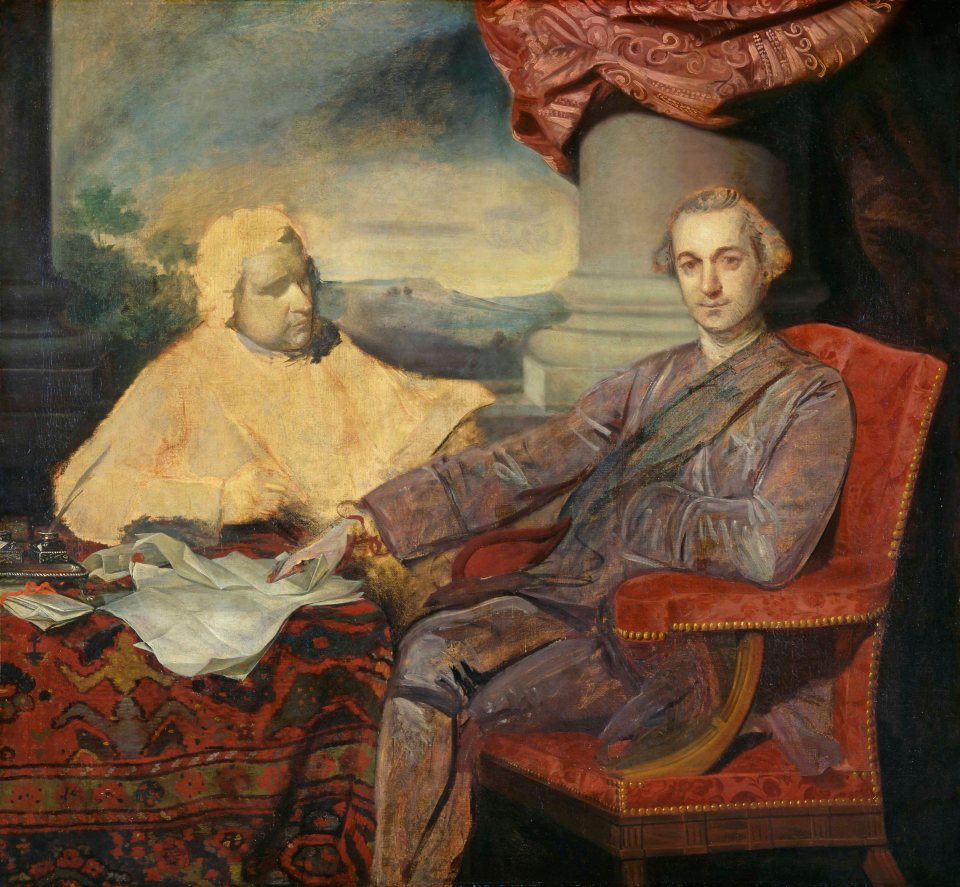
Portrait of Lord Rockingham and Edmund Burke (unfinished). Reynolds, Joshua (1723-1792). Oil on canvas, 145.4 x 159.1 cm, c.1766.
My friend and hero, Larry Reed, has written an excellent piece on Edmund Burke and the quest for real liberty over at FEE.org. Please check it out.
http://fee.org/articles/among-a-people-generally-corrupt-liberty-cannot-long-exist/
I would only add this to Larry’s great piece: that Burke was even more radical than Smith, noting in his 1795 paper on scarcity that government intervention in the market–at whatever level–always endangers security and prosperity. He also noted that the free working market allowed for “discovery.”
 Stormfields