

Hawthorne and American Transcendentalism (Full Lecture)

One of America’s first and finest conservatives, Nathaniel Hawthorne.
Five Points to Understand The Thought of John C. Calhoun

I. Pre-Compromise of 1820 Nationalism
Let it not be forgotten, let it be forever kept in mind, that the extent of the republic exposes us to the greatest of calamities—disunion,” Calhoun warned as Secretary of War in February 1817. “We are great, and rapidly—I was about to say fearfully—growing. This is our pride and danger, our weakness and our strength. . . . We are under the most imperious obligations to counteract every tendency to disunion. . . . Whatever impedes the intercourse of the extremes with this, the centre of the republic, weakens the union. . . . Let us, then, bind the republic together with a perfect system of roads and canals. Let us conquer space.
II. Post-1820 Theory (very Roman republican and very Calvinistic) as most fully expressed in The Disquisition on Government
Arts and Letters in Jacksonian America (Full Lecture)

The master of 19th-century American literature, Nathaniel Hawthorne.
A detailed look at the rise of romanticism and transcendentalism in Jacksonian America.
Herodotus on the 300
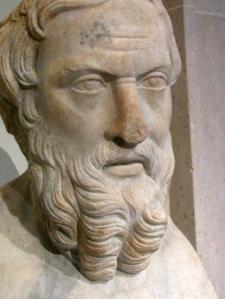 Herodotus described it well:
But Xerxes was not persuaded any the more. Four whole days he suffered to go by, expecting that the Greeks would run away. When, however, he found on the fifth that they were not gone, thinking that their firm stand was mere impudence and recklessness, he grew wroth, and sent against them the Medes and Cissians, with orders to take them alive and bring them into this presence. Then the Medes rushed forward and charged the Greeks, but fell in vast numbers: others now took the places of the slain, and would not be beaten off, though they suffered terrible losses. In this way it became clear to all, and especially to the king, that though he had plenty of combatants, he had but very few warriors.[1]
The Greeks—organized in units by their respective towns—continued to fight, despite suffering severe wounds and being greatly outnumbered. After days of battering, the Greeks decided to break up their defense. Some would stay, others would return to their respective city-states to warn them and to help them prepare for a defense. The Spartans, under the leadership of King Leonidas, decided to stay. The Oracle had prophesized either greatness or ruin for them, and they believed they would attain the former through sacrifice. Should they flee to defend their homes, Leonidas believed, all would be lost. Allied with the Thespians, who refused to abandon the Spartans, Leonidas and three-hundred men made their last stand. They drove themselves to the heart of the narrow pass at Thermopylae. There, they freely drove themselves into the Persians, mostly conscripts, being forced to fight by bullwhips at their backs. Leonidas threw himself into the invading force and died quickly.
Drawing back into the narrowest part of the pass, and retreating even behind the cross wall, they posted themselves upon a hillock, where they stood all drawn up together in one close body, except only the Thebans. The hillock whereof I speak is at the entrance of the straits, where the stone lion stands which was set up in honour of Leonidas. Here they defended themselves to the last, such as still had swords using them, and the other resisting with their hands and teeth; till the barbarians, who in part had pulled down the wall and attacked them in front, in part had gone round and now encircled them upon every side, overwhelmed and buried the remnant which was left beneath showers of missiles.[2]
Overwhelmed by the numbers of Persians, the Greeks fell quickly. As they did, they continued to fight, inspired by one officer declaring “If the Medes darken the sun, we shall have our fight in the shade.”[3]
The mission at Thermopylae was vital to the defense of Hellas itself. For, as Leonidas and his three-hundred Spartans sacrificed their lives, attempting to hold the pass at Thermopylae against the horde of Persian invaders, Athens had time to prepare a defense. When the last Greek died, the West was born.
[1] Heroditus, The History, Book VII.
[2] Heroditus, The History, Book VII.
[3] Heroditus, The History, Book VII.
Democratic Party Origins (Full Lecture)
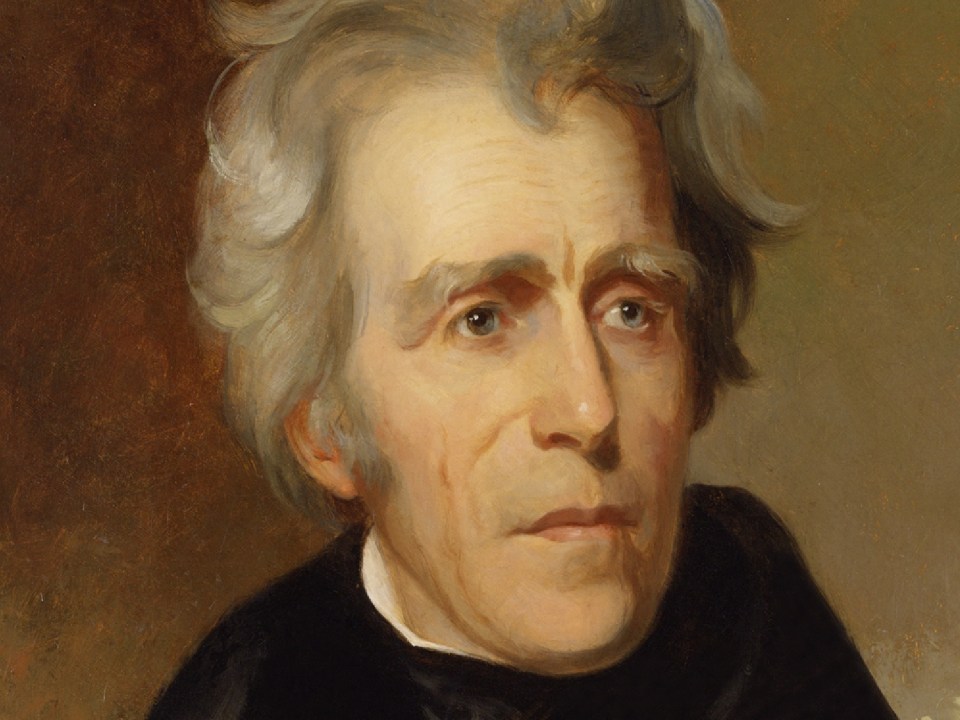
The originator of executive overreach.
The origins of the Democratic Party, the unconstitutionality of parties, and the arrival of Manifest Destiny. Full lecture.
Interviewing Mike Church, 2012
One of the coolest moments of my career, interviewing Mike Church–The King Dude–five years ago. A great man with great ideas.

Mike Church, Master of the Airwaves
***
Bearers of the Word: The Incomparable Mike Church
I don’t think I could exaggerate my respect for conservative (small “r” republican) radio host Mike Church as a person and as a personality. A man of immense tenacity, curiosity, and intelligence, Church has become one of the most interesting figures in national media. Though many of his competitors commodify and debase conservatism, Church reads, explores, and questions the most significant issues of our day. He explores the past and honors those who came before us, but not uncritically.
Tocqueville: Aristocracy and Soft Despotism (Full Lecture)

One of the greatest thinkers of western civilization.
Civil War Midterm Study Guide, 2017

Yes, I favor some good things, but I’m still a terrorist!
Midterm 2017 Study Guide; Sectionalism and Civil War
Instructor, grader, and would-be arbitrary Potentate: Bradley J. Birzer the Pitt Elder
Section 1: Essay. “Explain the causes of the Civil War.” To cover the topic fully, you should include the issues discussed over the past eight weeks: slavery, nationalism, republican thought, economics, religion, demographics, the constitution and politics, etc. Please remember that you are making an argument and must support it with appropriate evidence—from lectures as well as from the assigned readings in the course.
Section 2: Definitions. I will give you four (4) terms, and you will need to define two (2) of them. To answer correctly, you must address the how, what, who, where, when, and why of each. Possible I.D.s:
Abolitionism
Abraham Lincoln
Amistad
“Bleeding Kansas”
“popular sovereignty”
1850 Fugitive Slave Law
Compromise of 1850
Democratic Party
James Buchanan
Jefferson Davis
John Brown
Kansas-Nebraska Act
Missouri Compromise of 1820
Prigg v. Pennsylvania
Robert Anderson
Republican Party
Slavery, importation of. . .
Uncle Tom’s Cabin
Wilmot Proviso
Section 3: 25 short answers. A mix of sorting, fill-in the blanks, quote identifications, and multiple choice.
For My Jewish Brethren
A man, if he venerates the ashes of his fathers and the temples of his gods, will seek out the terror and strike with all the strength that is in him.
–Russell Kirk, 1954 (adapted from Macaulay’s LAY OF ANCIENT ROME)
Terry Anderson’s SOVEREIGN NATIONS OR RESERVATIONS (1995)
My very first ever published book review.
 Terry L. Anderson, Sovereign Nations or Reservations?: An Economic History of American Indians (San Francisco: Pacific Research Institute for Public Policy, 1995), xvii + 202 pages.ISBN: 0-036488-81-6. Forward by Wilcomb E. Washburn. [reviewed for PACIFIC NORTHWEST QUARTERLY]
Falling neatly within the recent revival of interest in Indians as entrepreneurs and “middle grounders,” Anderson’s book considers the Indians as neither noble savages nor New-Age environmentalists. Rather, he considers them fully human—religious, social, cultural, and economic beings. Informed by the “institutional environment” theories of Douglass North and the public choice theories of Gordon Tullock and James Buchanan, Anderson, a professor of economics at Montana State University and Executive Director of the Political Economy Resource Center, attacks the current explanations for the penury prevalent on many Indian reservations. Long before Europeans and Americans entered the scene, he argues, Indians throughout North America had developed cultural norms and customs that included effective property and individual rights specific to tribal needs and goals. Anderson discusses these spontaneous and varied norms in such areas as land ownership and use, fishing and hunting rights, and personal property. “Faced with the reality of scarcity,” Anderson argues, “Indians understood the importance of incentives and built their societies around institutions that encouraged good human and natural resource stewardship” (p. 43). Native-American cultures that thrived, necessarily evolved.
 Stormfields