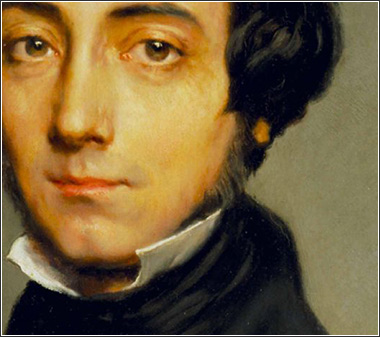
Alexis De Tocqueville
Voluntary associations have played a vital and pervasive role in the development of the American frontier and West, as well as for the United States as a whole. In an oft-quoted passage, Alexis de Tocqueville wrote in Democracy in America:
Americans of all ages, all stations in life, and all types of disposition are forever forming associations. There are not only commercial and industrial associations in which all take part, but other of a thousand different types—religious, moral, serious, futile, very general and very limited, immensely large and very minute. Americans combine to give fêtes, found seminaries, build churches, distribute books, and send missionaries to the antipodes. Hospitals, prisons, and schools take shape in that way. Finally, if they want to proclaim a truth or propagate some feeling by the encouragement of a great example, they form an association. In every case, as the head of any new undertaking, where in France you would find the government or in England some territorial magnate, in the United States you are sure to find an association.[i]
Despite the obvious significance of voluntary associations to American culture, an examination of the historical literature reveals that only a few scholars, often working in temporal concentrations separated by decades, have taken any deep interest in their importance for U.S. history as a whole; and only rarely has that interest manifested itself in the histories of the American West. The interest began, of course, with Tocqueville who probably was inspired by the Anglo-Irish political philosopher Edmund Burke, and can also be found in the writings of Frederick Jackson Turner, the founder of frontier history.[ii] A new concentration, beginning in the 1950s, after the revived interest in Tocqueville in the 1940s, originates with historical sociologist Robert Nisbet (himself a self-avowed Tocquevillian) and historians Daniel Boorstin, Oscar and Mary Handlin, and Rowland Berthoff in the 1960s and 1970s.[iii] A revival—its strength and longevity remains to be seen—began anew in 1995 with the publication of Robert D. Putnam’s whimsically titled article “Bowling Alone: America’s Declining Social Capital” and Robert Wiebe’s book Self-Rule. Anne Firor Scott’s 1991 Natural Allies has undoubtedly added to the revival as well. Of the literature that does exist, most of it is seemingly sympathetic.
As Robert Nisbet persuasively argues, Tocqueville was a French Burkean who viewed community and its interaction with the individual as organic. For Tocqueville, this organic or natural quality of American voluntary associations allowed them to promote both equality and liberty. Contrasting the hierarchy of the aristocratic society, the French political observer argued that the rampant individualism of American society made everyone equally weak, thus forcing them “to help each other voluntarily” to survive. Just as important, people who had “lost the power of carrying through great enterprises by themselves, without the faculty of doing them together, would soon fall back into barbarism.” According to his logic, a stable American individualism both precipitates and depends upon voluntary unification.
As for liberty, Tocqueville contended, the natural formation of voluntary associations allows Americans to do for themselves what governments in Europe might do for their citizenry. America, in this respect, was superior to Europe. Governments and bureaucracies, Tocqueville claimed, are neither organic nor subtle. They are unable to make nuanced or delicate decisions, as can voluntary associations in which “[f]eelings and ideas are renewed, the heart enlarged.” Governments, try though they might, are incapable of changing the true morals or being of the individual. “Once [government] leaves the sphere of politics to launch out on this new track,” argued Tocqueville, “it will, even without intending this, exercise an intolerable tyranny.” Worse, the control of societal change and growth is a zero-sum game. If the citizenry controls the power to make decisions, the government must be necessarily and proportionately smaller. In a “vicious cycle,” the reverse is also true. “The more government takes the place of associations,” Tocqueville wrote, “the more will individuals lose the idea of forming associations and need the government to come to their help.”[iv]
Frederick Jackson Turner gave a deferential nod to Tocqueville and addressed the importance of voluntary associations in his 1918 speech before the State Historical Society of Minnesota entitled “Middle Western Pioneer Democracy.” The natural ability to form spontaneous associations without the aid or interference of government, Turner claimed, is an inherent American trait. In the Old World, such things could only be accomplished by government compulsion and domination. The “backwoods democrats” of America “hated the doctrine of autocracy even before it gained a name.” Updating Jefferson’s concept of the natural aristocracy, Turner argued that spontaneity, competition, and voluntary action allow “the abler man . . . [to] reveal himself, and show them the way.” This absence of government also permitted individuals to feel confident, optimistic, and enthusiastic about themselves and their society.[v]
After nearly three decades of academic neglect, interest in Tocqueville, community, and voluntary associations arose in the thirty years following World War II. In 1953, Nisbet published his first book, The Quest for Community: A Study in the Ethics of Order and Freedom, a sophisticated work in which he argues that organically-evolved communities, associations (not always voluntary), and tight social bonds are essential to ward off both licentious individualism and a pernicious Leviathan, the mammoth and intrusive state. After surveying the debates in western civilization from the Greeks through the Scholastics through the present, Nisbet concludes that the West is caught between
two worlds of allegiance and association. On the one hand, and partly behind us, is the historic world in which loyalties to family, church, profession, local community, and interest association exert, however ineffectually, persuasion and guidance. On the other is the world of values identical with the absolute political community—the community in which all symbolism, allegiance, responsibility, and sense of purpose have become indistinguishable from the operation of centralized political power.[vi]
Organic, intermediary institutions—not always voluntary—offer alternative authority to the federal government. Ironically, the conservative Nisbet significantly influenced the social thought and action of numerous leftists in the 1960s.[vii]
____
[i] Tocqueville, Democracy in America, 513.
[ii] On Burke’s profound influence on Tocqueville, see Robert Nisbet, Conservatism: Dream and Reality (Minneapolis: University of Minnesota, 1986). For Turner, see his “Middle Western Pioneer Democracy” in Rereading Frederick Jackson Turner: ‘The Significance of the Frontier in American History’ and Other Essays, ed. John Mack Faragher (New York: Henry Holt, 1994), 159-80.
[iii] On the renewed interest in Tocqueville, see John Higham, History: Professional Scholarship in America, rev. ed. (Baltimore: Johns Hopkins University Press, 1989), 221. Regarding Tocqueville’s influence on Robert Nisbet, see J. David Hoeveler, Jr., Watch on the Right: Conservative Intellectuals in the Reagan Era (Madison: University of Wisconsin Press, 1991), chapter 7. Looking back on the time he first read Democracy in America, Nisbet wrote, “I am not likely myself to forget soon the thrill. . . . Of a sudden, a great deal about modern Western history an society took on new meaning for me” (Hoeveler, 181). The debate over community—the much larger issue encompassing voluntary associations—is simply too big to treat here with any integrity.
[iv] Tocqueville, Democracy in America, 514-6.
[v] Turner, “Middle Western Pioneer Democracy,” 166-8.
[vi] Robert Nisbet, The Quest for Community: A Study in the Ethics of Order and Freedom (New York: Oxford University Press, 1953), 280. For a more recent work, see Robert Nisbet, The Present Age: Progress and Anarchy in Modern America (New York: Harper & Row, 1988), chapters 2 and 3.
[vii] Hoeveler, 182.


 This morning, over at The Imaginative Conservative, Eric Voegelin’s Gnosticism.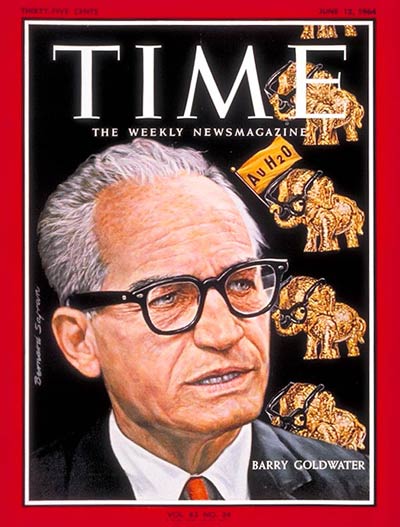
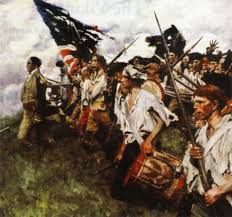 Opening to Crisis, 1763-1765


 A beautiful lightning essay by my former student and always-friend, Rachel Gough. Enjoy.
 Stormfields