
It’s a Far Cry: The Genius of Rush, Snakes, and Arrows — Progarchy

Snakes and Arrows, Rush’s 18th studio album, came out on May 1, 2007. It was the last Rush album to be distributed by Atlantic, but the first to be produced by Nick Raskulinecz. Snake and Arrows was profoundly progressive, but it was also one of Rush’s blues-iest album, almost certainly influenced by their EP, Feedback, […]
via It’s a Far Cry: The Genius of Rush, Snakes, and Arrows — Progarchy
A quarter of a century — elizabeth hamilton

A few days before my 25th birthday, several of my older friends admitted that on their 25th birthdays, they’d woken up feeling rather like someone had punched them in the face. They were no longer in their early twenties. They were 25 now. They needed to get their lives together. They needed to grow up. These were honest, innocent admissions, not […]
T.E. Hulme,SPECULATIONS (Full Book)

It is no exaggeration to state that without this man, there would be no 20th century conservatism.
T.E. Hulme’s posthumous masterpiece, SPECULATIONS. Hulme was the first conservative of the twentieth-century, influencing almost too many figures to count–but most importantly T.S. Eliot and Christopher Dawson.
First published in 1924, almost a decade after Hulme’s death in World War I.
Father Marvin O’Connell: One of the Greats
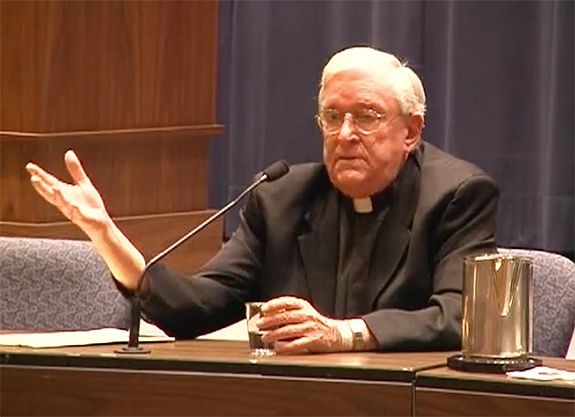
Not one of his students would ever accuse Father O’Connell of softness, favoritism, or sloth. He was a fierce man, a fierce priest, and a fierce professor. He possessed perhaps the most penetrating and intelligent eyes and brow I have ever encountered in a teacher. He had a booming voice, and he loved to quote Churchill. Sometimes, he would break into a Churchill speech when trying to explain some complexity of history. Certainly, the most memorable moment in any class I took in college was O’Connell’s full recitation of Churchill’s speech of May 1940, his first speech—“the finest hour” as Prime Minister. I was fairly certain that Churchill was, in fact, standing in our classroom in O’Shannessey Hall at Notre Dame in that fall of 1988. It’s quite possible that O’Connell was shooting lasers and lightning from his eyes as he delivered this speech. Whatever it was, Father O’Connell cast a spell over the entire classroom, and we were ready to go to war against the Nazis, even if it meant our most certain death. Never have I felt a greater call to arms. When O’Connell finished, I looked around the room. There was nothing but stunned silence and a number of tears flowing from the eyes of his students.
To read my full obituary of this great man, please go here: http://www.catholicworldreport.com/Blog/5006/father_marvin_r_oconnell_requiescat_in_pace.aspx
SIDELIGHTS (1940) by Frank Sheed

Not beautiful, but effective.
A beautiful series of reflections on the nature of Christian Humanism in the 1920s and 1930s.
Frank Sheed, as is well known, was the architect behind the Christian Humanist revival of the first 1/3 of the twentieth-century.
Why The Graphic Novel Matters: Watchmen
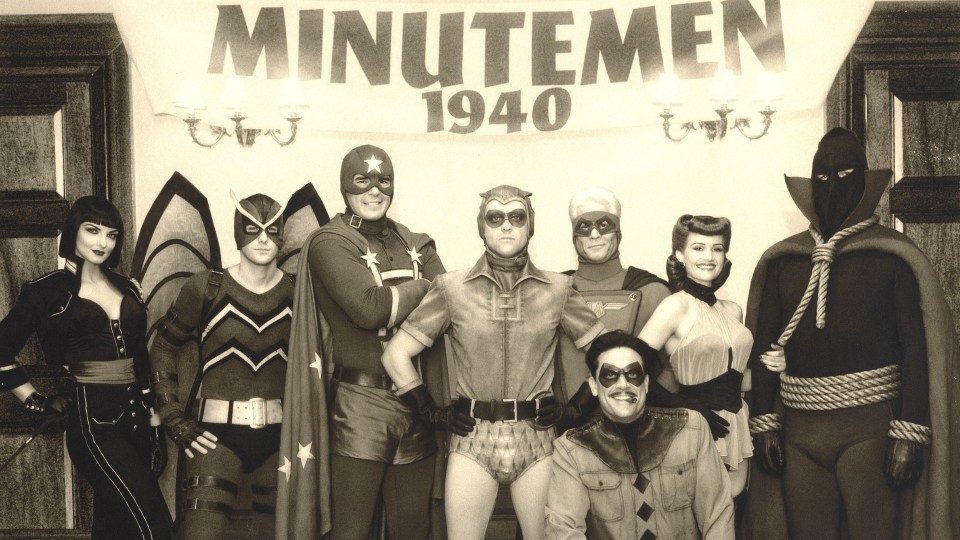
The story of The Watchmen takes place in an alternative or parallel 1985, a world deeply cynical, a world that found no solace after Nixon. Actually, somehow in 1985, Richard Nixon is still the president of the United States. The Cold War has become so intense that the clock of Atomic Scientists is only moments before midnight, an all-out nuclear war looms over the entire world. Where there had been a golden age of superheroes (akin to the all-American Superman), many of their followers had become less than virtuous. And, it turns out, not all that seemed to glitter in the first era of superheroes had been gold as well. Moore and Gibbons deal frankly with societal decay, with paranoia, with justice, with injustice, with child abuse, and with the role of conformity in society. Philosopher Aeon Skoble has written the single finest essay on The Watchmen) as graphic novel. In his own understanding, Dr. Skoble sees the story as much about real world events as it is about “the psychology as well as the ethical and political ramifications of vigilantism.” In other words, what is a man (or woman) to do, when the government corrupts rather than protects. When does it become not just a right to defend oneself against injustice but an actual moral and ethical duty to do so?
To read the whole piece, please go to The Imaginative Conservative. http://www.theimaginativeconservative.org/2016/08/high-cost-virtue-watchmen-bradley-birzer.html
Christopher Dawson: CHRISTIANITY AND THE NEW AGE (FULL BOOK)

Dawson’s 1931 masterpiece, CHRISTIANITY AND THE NEW AGE, plus his introduction to his fourteen-volume series, ESSAYS IN ORDER.
Syllabus: Jacksonian America, Fall 2016

John Quincy Adams (a better man than Jackson!)
H302: “Jacksonian America” aka Democratization of America, 1807-1848
Meeting Times: Tuesday/Thursday, Lane 124, 9:30-10:45
Instructor: Professor Bradley J. Birzer
Office: Delp 403
Description
Probably no generation after the American founding had a more diverse range of powerful personalities—John Quincy Adams, John Randolph of Roanoke, John Marshall, John Taylor of Caroline, Andrew Jackson, Henry Clay, John C. Calhoun, Joseph Smith, Martin Van Buren, James Fenimore Cooper, Ralph Waldo Emerson, and Henry D. Thoreau to name only a few. These personalities, essentially the children of the Founders, had to deal with the needs, the demands, and the intentions of the Republic. Importantly, they had to live up to what their fathers had given them from 1761 through 1793; they had to reify the ideals of the Republic. An unenviable task, to be sure. During these critical years, Americans wrestled with the formation of entirely new religions (many blatantly esoteric and Gnostic; others quite heterodox); the fragmentation and infighting of Protestantism; democratization in all aspects of American life; expansion westward and the various encounters with (usually outright brutal toward) American Indians; slavery and every one of its associated and attendant evils; reforms from the moderate and necessary to the outrageous and fantastic in all aspects of culture and politics; the establishment of America as a viable power among the nations of the world; the creation of political parties; and the development of American letters. To most Americans, economic and technological “progress” would allow the republic to transcend and overcome the limitations of the past, while the rising spirit of democracy would implant itself in the American West and throughout the world, by example or, if need be, by force. “Progress” and “destiny” and “individualism” became key words in the American vocabulary. Tellingly, the term “individualism” had never even appeared in print prior to 1827. Truly, something very different from the vision of the American founders emerged, a whole new American character–restless, expansive, violent, and suspicious of community.
Protestantism and Humanism
It is often thought—in part because of irresponsible polemic masquerading as scholarship or learned analysis from people who ought to know better, in part because of Protestants’ equally inexcusable neglect of their own tradition—that the Protestant Reformers held no brief for natural law or for the wisdom of the Greeks and Romans. Fewer claims sit less easily with the truth of things than this one; but it has by now become a convention, and, as conservatives know (and usually celebrate), conventions die hard.
The consensus position has begun to change in recent years due to a return ad fontes among many Protestant scholars. In this brief essay, I’d like to look at one example of why this consensus must continue to be modified in a more historically responsible direction: Philip Melanchthon’s preface to Cicero’s On Duties, written in 1525. Melanchthon (1497-1560), one of the chief and most influential figures among both the Protestant Reformers and northern European humanists, found a wealth without parallel for the study of ethics in Greek and Roman authors, and particularly in the writings of Cicero and Aristotle; and the former’s On Duties held a position in the first rank for him (as, indeed, it did later for the American Founders).
Christopher Dawson, BEYOND POLITICS (Full Book)
Sketch by Sam Torode
Enjoy this pdf of Dawson’s 1939 book, BEYOND POLITICS. An extraordinary effort on great man’s part.
MODERN DILEMMA by Christopher Dawson (full book)

Unicorn design by David Jones.
A short but brilliant 1932 book by Christopher Dawson. Well worth reading, especially in this insane and violent age.
Bob Murphy and Austrian Economics: Liberty Classroom
Dear Liberty Classroom member:
All the lectures for Robert Murphy’s course on the history of economic thought are now available: http://www.libertyclassroom.com/courses/history-of-economic-thought-part-i-classical-economics-and-the-marginal-revolution/
Some serious knowledge bombs are dropped in this course, taught by one of the best Austrian School economists working today.
Meanwhile, we’ll be resuming our live sessions this month (we’ll do more than one!) on a new platform, Webinar Ninja, now that Spreecast has closed down. Watch these emails for the dates.
Finally, a word to homeschoolers: if you’re considering the Ron Paul Curriculum, be sure to grab it through my special link, since only there do you get my $160 worth of free bonuses: http://www.RonPaulHomeschool.com
Cordially,
Tom Woods
Creator, Liberty Classroom
 Stormfields