
On Losing a Child: Ten Years Later
Dear Friends, I want to thank you so much for all of the wonderful and heart-warming comments about our Cecilia Rose (this past Tuesday) and what would’ve been her tenth birthday. For whatever reason, we felt more at peace with her absence than ever before. No matter what, pain and anxiety always come that day, and always will. Such is life. For the first time since her death, however, I, at least, accepted it, even if I still hated it.
A couple of you expressed how impressed you were at our faith. All credit to Dedra for this. She’s the strong one, and she’s the one who keeps (through God’s grace) our faith as a family at its best.
I’ve spent close to the last ten years being VERY angry with God. My main thought was, how could God give us children ONLY to take them away? As parents, we have one main job: to protect and nurture our children. How can we do that when we’re not even given a chance?
THE AMERICAN CONSERVATIVE Print Subscription: $12/year

$12/year print subscription
If you’re an #FOB–no! not “friend of Bill”! FRIEND OF BRAD–you can get a year’s print subscription to The American Conservative for just $12.* Yes, truly, $12!
If you’d like the $12 subscription–
1. Email us at fobtheamericanconservative@gmail.com**
2. Put #FOB in the subject line
3. Give us your mailing (physical) address in the actual message
Within a few days, we’ll email you the link to pay your $12 and get a year’s worth of The American Conservative.
+++
*only for those with a U.S. postal address.
**yes, this is an outrageously convoluted email address.
Edmund Burke’s Disney: BEAUTY AND THE BEAST

The Image of Grace Itself
What if? Why Disney’s BEAUTY AND THE BEAST (2017) is one of the most Burkean movies ever made.
As the movie was ending, I thought, I might very well be reading too much into this, wanting to find Christianity in the story simply because I fell in love with the story. Then, my patience and thought was more than rewarded. As the spell was lifted from the castle of the Beast, the last thing to transform was the very top of the castle, a rather eerie gargoyle overlooking the cursed realm. When it changes, it doesn’t just become less creepy, it becomes truly holy. The gargoyle transforms into St. Michael slaying the devil. Truly, literally. Right there on a Hollywood movie screen—seen by millions of movie goers—is the symbol of the entire movie, a statue of St. Michael in victory against the devil. How amazing is that?
To read the full review, please go here: http://www.theimaginativeconservative.org/2017/07/moral-imagination-disney-beauty-beast-bradley-birzer.html
Interim President and CEO of THE AMERICAN CONSERVATIVE
 Dear Friends,
I am extremely honored to announce that I have been named the interim President and CEO of The American Conservative magazine and its parent NPO. It is interim—a one-year position as steward (Faramir) as we search for the return of the king (Aragorn).*
My position with TAC will, in no way, affect my day-to-day duties (or loyalties) to Hillsdale College or The Imaginative Conservative.
Indeed, it is clearly Winston Elliott and his magisterial The Imaginative Conservative and the experience and opportunities it has offered me that paved the way toward the interim position with TAC. TIC-TAC! Ave, Winston.
And, of course, a huge thanks to my great friends, Dan McCarthy, Mark Kalthoff, and Tom Woods, for their encouragement. And, to Sarah Skwire and Steve Horwitz, too. Oh yeah—that mighty Johnny Burtka as well!
As it always has, The American Conservative seeks and will continue to seek “ideas over ideology” and “principles over party.”
Yours, delightedly, Brad
*This makes Dedra, Eowyn. Makes perfect sense.
Barry Goldwater’s 1962 Notre Dame Address
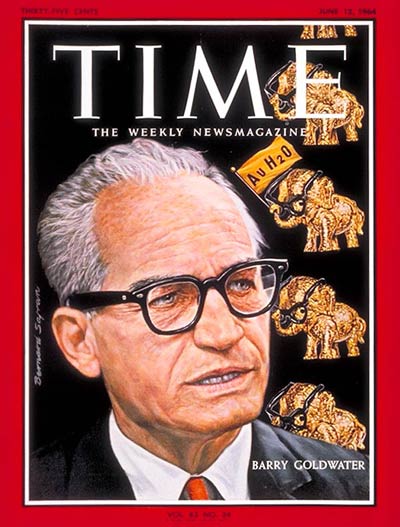 Though Russell Kirk only wrote two speeches for Senator Barry Goldwater, they were very, very good speeches.
The two men made a mighty and rather natural team, bringing the best out of each other.
Here’s the one he wrote for Goldwater’s 1962 visit to the University of Notre Dame.
The Failure of American History Textbooks
 What are the good American history textbooks out there?
The best one, by George Tindall and David Shi, declines in quality (but not quantity!) with every new edition. Here’s a telling example. The text, America: A Narrative History (brief 9th ed.), gives the impression that Maryland was somehow a semi-tolerant Catholic colony.
This is demonstrably untrue after 1689.
Beginning with the so-called “Coup of 1689” and the full repeal of the Toleration Act of 1649, Maryland instituted the strongest and most effective anti-Catholic laws in the North American colonies. A practicing Catholic:
- Couldn’t vote
- Couldn’t hold office
- Couldn’t bear witness/testify in a court of law
- Couldn’t practice law
- Had to practice his religion, ultimately, in a private chapel
- Had his land double (and sometimes more) taxed; additionally, his land was always liable to confiscation during times of war, especially if against Catholics
- Often could not raise a child in the “Catholic fashion” without having the child forcibly removed from the Catholic parent(s) and shipped to England to live with a Protestant family.
The end of such laws also reveal the power of the American Revolution, for the extra legal associations of 1774 swept aside these laws, even as the First Continental Congress condemned the Quebec Act on October 21, 1774, viewing the act as a “power, to reduce the ancient, free Protestant colonies to . . . slavery. . . Nor can we suppress our astonishment that a British parliament should ever consent to establish in that country a religion that has deluged your island with blood, and dispersed impiety, bigotry, persecution, murder and rebellion through every part of the world.”
What a world.
True Educational Reform
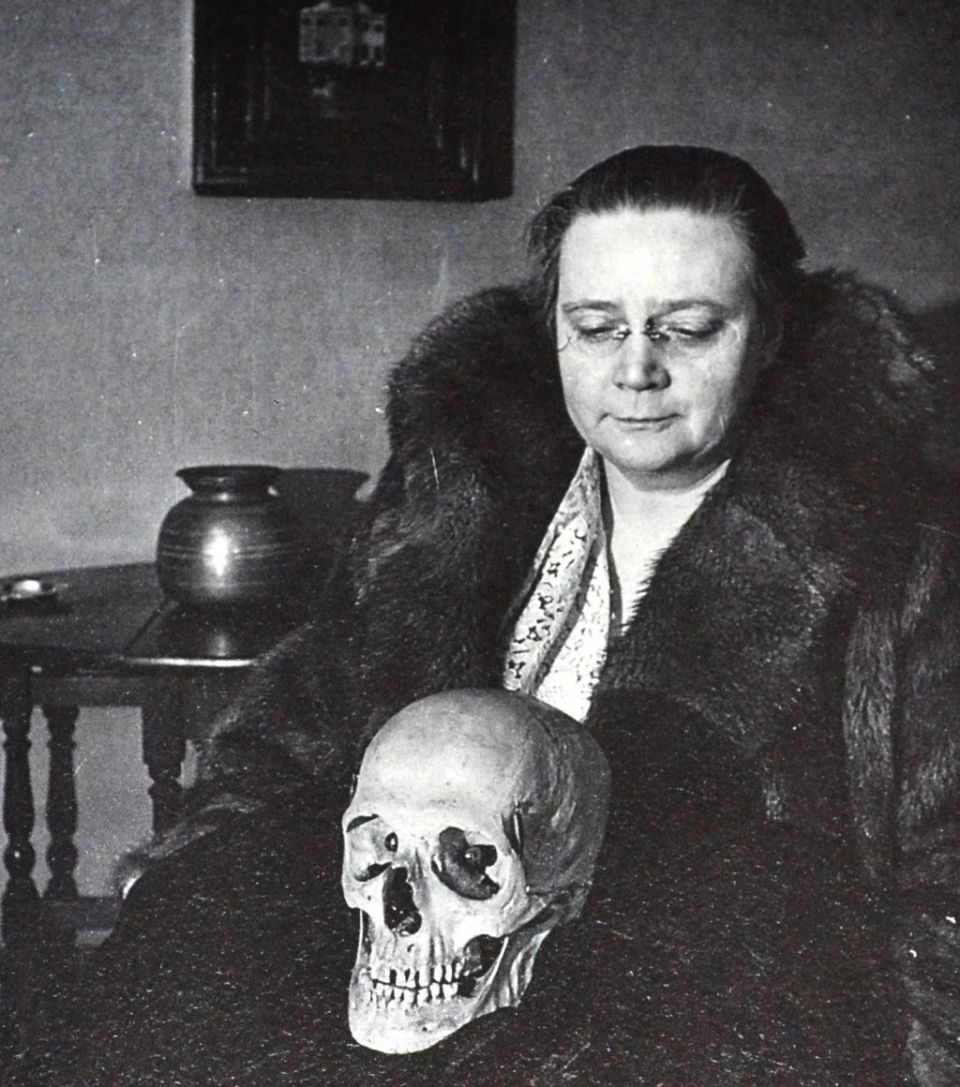
Dorothy Sayers contemplating the last things.
[From a few years ago. . .]
As I had mentioned in a previous post, I’m heading to Indianapolis this weekend for a conference on the meaning of liberty and education. One of the finest books I’ve come across in preparation for this colloquium is Liberty Funds on 1973 book, Education in a Free Society. The book concludes with Dorothy Sayers classic piece, “The Lost Tools of Learning.” Originally written at the beginning of the Cold War and delivered at Oxford, Sayers’s piece has as much to tell us now—if not more–than it did in the 1940s.
As Sayers believes it, western civilization was in slow decline, in large part, because it relied so heavily on the educational inheritance of previous generations. But, it was using up that inheritance as quickly as possible, approaching the point of its complete disintegration.
“Many people today who were atheist or agnostic and religion, are governed in their conduct by a code of Christian ethics which is so rooted in their unconscious assumptions that it never occurs to them to question it. But one cannot live on capital for ever. A tradition, however firmly rooted, if it is never watered, though it dies hard, yet in the end it dies.”
Like other Christian humanist critics of the time, especially Albert Jay Nock, Romano Guardini, and Christopher Dawson, Sayers worried that with the declining importance of the liberal arts, not only would education become compartmentalized into a variety of “subjects,” but that those educated in such a system would take their own subjective preferences into society itself. Consequently, a man might know much—that is, he might know an outrageous number of facts—about a thing, but he would be unable to place that thing into a larger and important context. In other words, he would prefer the particular to the universal, perhaps not even knowing a universal existed. One might consider this educated man incredibly knowledgeable, but no one would mistake him for being wise.
The Genius of Sir Thomas More
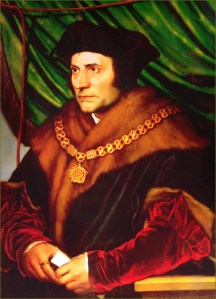 Sir Thomas More (1478-1535)
An argument could be made that the world ended when Henry VIII had Thomas More executed. Or, perhaps, in less drastic terms, the “modern world” began on July 6, 1535. What was left of the world of Christendom faded away at that moment. This argument actually seems more plausible than the claim that some historians have made that the modern world began with Luther and Calvin. In almost every way, Luther and Calvin–with More, John Fisher, and Erasmus–looked first and foremost to the past for guidance and inspiration. Luther was a devout Augustinian, and Calvin’s first love was the Stoicism of Seneca.
A few glimpses into More’s personal correspondence reveal much about his innocence and hope.
“For His wisdom better sees what is good for us than we do ourselves. Therefore, I pray you be of good cheer, and take all the household with you to church, and there thank God both for that He hath given us and for that He hath taken away from us, and for that He hath left us, which, if it please Him, He can increase when He will. And if it please Him to leave us yet, as His pleasure be it.” (Thomas More to Mistress Alice, September 3, 1529, in Steve Smith, ed., For All Seasons, letter 51)
“The more I realize that this post involves the interests of Christendom, my dearest Erasmus, the more I hope it all turns out successfully.” (Thomas More to Erasmus, October 29, 1529, in Steve Smith, ed., For All Seasons, letter 53)
“Congratulations, then, my dear Erasmus, on your outstanding virtuous qualities; however, if on occasion some good person is unsettled and disturbed by some point, even without a sufficiently serious reason, still do not be chagrined at making accommodations for the pious dispositions of such men. But as for those snapping, growling, malicious fellows, ignore them and, without faltering, quietly continue to devote your self to the promotion of intellectual things and the advancement of virtue.” (Thomas More to Erasmus, June 14, 1532, in Steve Smith, ed., For All Seasons, letter 54)
Paul Rahe’s De Tocqueville
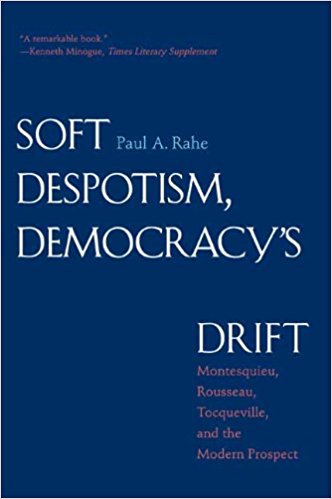 From a response, “Republican Virtue, Democratic Spirit,” delivered on April 7, 2009, at Hillsdale College to Paul Rahe’s excellent work on Alexis De Tocqueville.
Thank you, Professor Schlueter for organizing this and for inviting me to speak. Thank you, Miss Essley, for your kind introduction.
Professor Paul Rahe [professor of history and political science, Hillsdale College] is not a happy man. Nor should he be. From almost any perspective, the state of the world appears rather bleak.
Everywhere, we see an economy in tatters, a people uncertain, and a culture corrupted, perhaps beyond redemption. Perhaps. Stimulus packages, plans to add untold debt as a burden upon our children and grandchildren, and promises from the Federal Reserve to print money all should give us pause.
More immediate dangers exist. Across the Pacific, a missile was launched this weekend from a regime we should have eradicated in the early 1950s. We are now living with our previous errors in judgment.
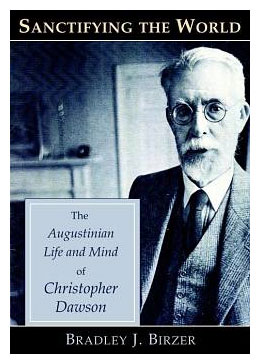
 To put it simply (and perhaps a bit “simplistically”—but I prefer to think of it as putting it “with fervor”), Christopher Dawson was one of the greatest historians of the twentieth century, certainly one of its greatest men of letters, and perhaps one of the most respected Catholic scholars in the English speaking world. I’ve have had the opportunity and privilege to argue this elsewhere, including here at the majestic The Imaginative Conservative. I would even go so far as to claim that Dawson was THE historian of the past 100 years.
Without going deeply into Dawson’s thought—or any aspect of it—in this post, it is worthwhile cataloguing how many of his contemporaries claimed him important and his scholarship and ideas for their own. This means, consequently, that while most Americans—Catholic or otherwise—no longer remember Christopher Dawson, they do often remember affectionately those he profoundly (one might even state indelibly) influenced. The list includes well known personalities such as T.S. Eliot, Thomas Merton, J.R.R. Tolkien, and C.S. Lewis.
An Important Note to Readers of Stormfields
Dear Stormfields readers,
First, thank you!
Second, for some reason beyond my control, WordPress erased almost 5,000 of you from my subscriber/followers list. This happened to me about 2 weeks ago at this account and also at my music website, progarchy.
I have no idea why.
Just please know that if you were taken off the subscriber/follower list, it was NOT personal!
Third, if you’d like to sign up again, I’d be more than happy to have you! Let’s hope it’s permanent this time.
Thank you for understanding,
Brad

 Stormfields