
St. Augustine’s Two Cities: Then and Now
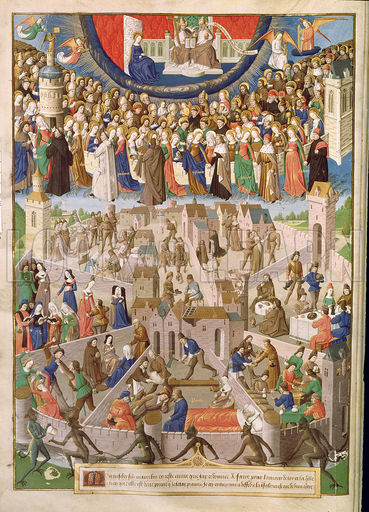 “Nature makes nothing in vain,” Aristotle, the great Pagan philosopher of ancient Athens, understood. Aquinas concluded Aristotle’s argument fourteen centuries later with “only Grace perfects nature.” Following St. Paul’s letters in the New Testament, St. Augustine, eight centuries before Aquinas and seven centuries after Aristotle, wrote: “All natures, then, inasmuch as they are, and have therefore a rank and species of their own, and a kind of internal harmony, are certainly good. And when they are in the places assigned to them by the order of their nature, they preserve such being as they have received.”[1] Nothing could sum up the argument of the Christian Humanists better than the arguments of these three men, one pagan and two Christians: Aristotle, St. Augustine, and St. Aquinas. Everything has its place, its role, its purpose, singular to it, known and understood only fully by the Divine Author, who placed each person and thing in His story, what a monk at the Anglo-Saxon monastery at Lindesfarne called “God’s Spell,” or the Gospel, in 950. The story in which we as human persons participate began with Creation, reached its middle and highest point with the Incarnation, the Death, and the Resurrection of Christ Jesus, and will end with the Apocalypse. The end will come when it comes. Even Jesus claimed not to know His Father’s mind and desires on the subject. Each of us, then, as members of the story, has our role. Some roles are greater, some are lesser, but each has an intrinsic importance. We may neglect our role, we may pervert our gifts, or we may freely give up our free will, through Grace, and submit to God’s Will. St. Augustine challenged his readers:
Choose now what you will pursue, that your praise may be not in yourself, but in the true God, in whom there is no error. For of popular glory you have had your share; but by the secret providence of God, the true religion was not offered to your choice. Awake, it is now day; as you have already awaked in the persons of some in whose perfect virtue and sufferings for the true faith we glory: for they, contending on all sides with hostile powers, and conquering them all by bravely dying, have purchased for us this country of ours with their blood; to which country we invite you, and exhort you to add yourselves to the number of citizens of this city.[2]
Man Will Never Dominate Nature
 In this world, the possibility of exploitation will become most violent when men not only deny God but attempt to dominate nature. C.S. Lewis explored the possibilities of men dominating nature during World War in both realistic and fictional media. “The final stage is come when Man by eugenics, by pre-natal conditioning, and by an education and propaganda based on a perfect applied psychology, has obtained full control over himself,” Lewis explained in The Abolition of Man.[1] Ironically, because this means that the generation that discovers this will overturn all previous generations and shape all future generations, this revolutionary generation will be a tyrant and dehumanize all. “They have stepped into the void,” Lewis argued. “They are not men at all: they are artefacts. Man’s final conquest has proved to be the abolition of Man.”[2] Lewis took the argument to its logical conclusion:
From the point of view which is accepted in Hell, the whole history of our Earth had led up to this moment. There was now at least a real chance for fallen man to shake off that limitation of his powers which mercy had imposed upon him as a protection from the full results of his fall. If this succeeded, Hell would be at last incarnate. Bad men, while still in the body, still crawling on this little globe, would enter that state which, heretofore, they had entered only after death, would have the diuturnity and power of evil spirits. Nature, all over the globe of Tellus, would become their slave; and of that dominion no end, before the end of time itself, could be certainly foreseen.[3]
Though written in fantastic terms, Lewis’s words from That Hideous Strength ring with truth, and Hell is the winner. Dawson agreed: the machine will become “the blind instrument of a demonic will to power.”[4] With such a victor, Romano Guardini warned, “unspeakable rape of the individual, of the group, even of the whole nation” will be the result, as the terror regimes of the twentieth-century have well demonstrated.[5] Indeed, in modernity, Etienne Gilson realized, knowledge itself is synonymous with destruction.[6]
Barbarians at the Gate

Cycles of Republics
At midnight, August 24, 410, Alaric and his Gothic warriors entered the gates of Rome and sacked the city, pillaging, raping, and murdering for nearly three solid days. Far from considering himself as a ruthless invader of Rome, Alaric viewed himself as a loyal Roman citizen as he entered the Eternal City. He and his men desired formal recognition as legitimate Roman armed forces through titles and pensions.[1] Though the empire had been crumbling for years due to cultural, political, and economic decadence, the event stunned and shattered the western world. And, whatever Alaric’s intentions on August 24th, his army degenerated quickly into a ravaging mob.[2] “When the brightest light on the whole earth was extinguished, when the Roman empire was deprived of its head and when, to speak more correctly, the whole world perished in one city,” wrote St. Jerome, expressing the common sentiment, “I was dumb with silence, I held my peace, even from good, and my sorrow was stirred.”[3] Such an event had seemed inconceivable to those living under the declining protection of the Roman empire. And, yet, it had happened. The great symbol of the vast Roman empire, though no longer the capitol, had fallen to invasion. True, many Christians and their Basilicas were spared, but the city had fallen nonetheless.[4] The ruin continued, St. Jerome lamented.
For twenty years and more Roman blood has been flowing ceaselessly over the broad countries between Constantinople and the Julian Alps where the Goths, the Huns and the Vandals spread ruin and death… How many Roman nobles have been their prey! How many matrons and maidens have fallen victim to their lust! Bishops live in prison, priests and clerics fall by the sword, churches are plundered, Christ’s altars are turned into feeding-troughs, the remains of the martyrs are thrown out of their coffins. On every side sorrow, on every side lamentation, everywhere the image of death.[5]
Though also reeling from the onslaught of the Barbarians, St. Augustine stood firm in his opposition to the pagans and their challenge that Rome fell because it ignored the old gods. Gracefully, he turned the evil of destruction of the barbarians into the creative good of the Church. His defense came in the form of one of the greatest works of Christianity, The City of God (413-426). It would be difficult to exaggerate the importance of this work, as it became the theological, social, cultural, and political handbook, along with scripture, for the middle ages.[6] Through the writing of the City of God, he also importantly came to realize that though Rome may have fallen, Christianity stood strong. “Though he was a loyal Roman and a scholar who realized the value of Greek thought, he regarded these things as temporary and accidental,” Christopher Dawson explained. “He lived not by the light of Athens and Alexandria, but by a new light that had suddenly dawned on the world from the East only a few centuries earlier.”[7] Rome represented the City of Man, in its paganism, decadence, and torture of Christians; Jerusalem represented the City of God.[8] For St. Augustine, one could not readily separate the two cities, the City of God and the City of Man, in any strict dualism or profound opposition. “In truth,” St. Augustine wrote, “these two cities are entangled together in this world, and intermixed until the last judgment effect their separation.”[9] The world experienced two types of time: the cyclical time of the City of Man, and the purposeful time of the City of God, a group of pilgrims making their way through this time, but not of this time.
As with St. Augustine, the Christian Humanists of the twentieth-century looked out over a ruined world: a world on one side controlled by ideologues, and, consequently, a world of the Gulag, the Holocaust camps, the killing fields, and total war; on the other: a world of the pleasures of the flesh, Ad-Men, and the democratic conditioners to be found, especially, in bureaucracies and institutions of education. Both east and west had become dogmatically materialist, though in radically different fashions. In almost all ways, the devastation of Kirk’s and Dawson’s twentieth-century world was far greater than that of St. Augustine’s fifth-century world. At least barbarian man believed in something greater than himself. One could confront him as a man, a man who knew who he was and what he believed, however false that belief might be. But, modern man accepted only ideologies, the false and substitute religions of modernity.
Fifteen centuries after St. Augustine, the barbarians were at the gates.
Notes
[1] Warren Thomas Smith, Augustine: His Life and Thought (Atlanta, Georgia: John Knox Press, 1980), 145.
[2] J.B. Bury, The Invasion of Europe by the Barbarians (New York: W.W. Norton, 1967), 96.
[3]St. Jerome quoted in Daniel Boorstin, The Creators, 59
[4] Smith, Augustine, 145-47.
[5] Quoted in Dawson, Enquiries into Religion and Culture, 221.
[6] Dawson, Religion and the Rise of Western Culture, 68; and Dawson, Enquiries into Religion and Culture, 199.
[7] Dawson, “The Hour of Darkness,” The Tablet (December 2 1939), 625.
[8] Dawson, “The Hour of Darkness,” 625.
[9]St. Augustine, The City of God, Book 1, Section 35.
Is Ideology Attractive?

To what end were 200 million human persons—created in the Image of God—murdered, one must ask? And, why did millions more suffer for being simply human persons, unique, unfathomable, unrepeatable? The answer, unfortunately, is not an easy one, and very few scholars—historians, philosophers, or theologians—have attempted to answer this question. In 1886 Friedrich Nietzsche, the mad prophet of the modern man, wrote, “The greatest event of recent times–that “God is Dead”, that the belief in the Christian God is no longer tenable–is beginning to cast its first shadows over Europe.” Like Lewis’s unnamed opponents in late February 1943, Nietzsche further argued that traditional morality and received understandings of character and virtue were merely a means to shackle the true individual, to restrain and attenuate his pagan self. Such constraints, Nietzsche contended, were culturally manufactured, not inherent in nature. By throwing off the artificial restraints, Nietzsche continued, one would discover his true self. Perhaps most important, as Nietzsche understood at the end of the nineteenth-century, men had forgotten God, establishing themselves as the highest authority in the universe. The results, he believed, were predictable. De-spiritualized, “Our whole European civilization is moving with a torture of tension, which increases from decade to decade, toward a catastrophe,” he wrote three decades before World War I. With the de-spiritualization of Europe, strangely enough, the mad philosopher argued, the coming destruction would result from a “war of the spirits.”[1]
This frightful destruction did not drop down from heaven; in truth it rose up out of hell! A culture marked by a true ordering could not have invented such incomprehensible systems of degradation and destruction. Monstrosities of such conscious design do not emerge from the calculators of a few degenerate men or of small groups of men; they come from processes of agitation and poisoning which has been long at work. What we call moral standards—responsibility, honor, sensitivity of conscience—do not vanish from humanity at large if men have not already been long debilitated. These degradations could never have happened if its culture had been as supreme as the modern world thought.[2]
Lamentations of an Old Republican
Reflections from a Memorial Day, 8 years ago.

“Lamentations of an Old Republican: Remembering”
Last Thursday morning, I stood on the Lexington green with my beautiful and sagacious wife, my five very active and somewhat mischievous children, the talented Ben Cohen (acting as Paul Revere; and who also turned out to be a supporter of Hillsdale College), the vivacious Malana Salyer of Gary Gregg’s McConnell Center, and roughly twenty-seven teachers from Kentucky.
As “Paul Revere” described the battle on the commons that morning–the Lexingtonians greatly outnumbered by the advancing British–I felt immensely humbled.
“Revere” pointed out the buildings, oriented us, described the troop movements, explained the ideas the Lexingtonians held as they stood at ready, and the consequences of the actions taken in April 1775. One Lexingtonian, shot on the green, even crawled back to his house, literally across the street, and into his wife’s arms to die.
Last Thursday, I stood at the very birthplace of America.
Despite the rain, despite the photos being taken, and despite the restless children, I could only think of that moment, 234 years earlier. A moment touched by honor, touched by manhood, touched by virtue, touched by patriotism, and, most importantly, touched by sacrifice. Indeed, one might even write, saturated with sacrifice.
The Pervasive Influence of Christopher Dawson
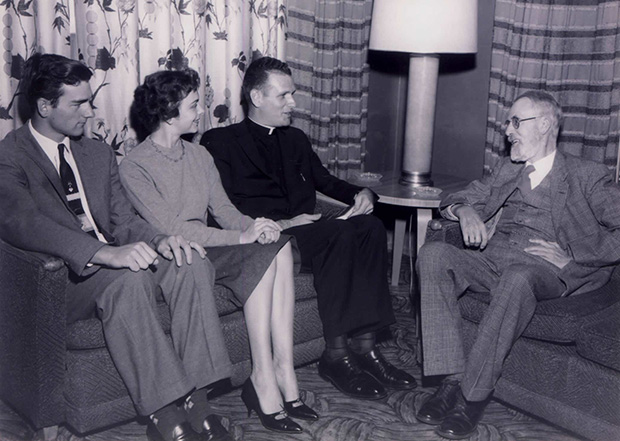
Though few—Catholic or otherwise—remember him now, Christopher Dawson once stood at the very center of the Catholic literary and intellectual revival the four decades preceding Vatican II. “For Dawson is more like a movement than a man,” his publisher and friend, Frank Sheed, wrote of him in 1938. “His influence with the non-Catholic world is of a kind that no modern Catholic has yet had, both for the great number of fields in which it is felt and for the intellectual quality of those who feel it.”[1] Excepting Jacques Maritain and Etienne Gilson—though only briefly and certainly with some hesitation—it would be difficult to find a more prominent Roman Catholic scholar not only in the English speaking world, but throughout the Catholic world and beyond during those forty years.[2] As Maisie Ward, co-founder of and editor for Sheed and Ward, the most important Catholic publisher of the middle of the twentieth-century, admitted to Dawson, “You were, as I said on Sunday, truly the spear-head of our publishing venture.”[3] Ward put it into greater context in her autobiography, Unfinished Business. “Looking back at the beginnings of such intellectual life as I have had, I feel indebted to three men of genius: Browning, Newman, and Chesterton,” she wrote. “But in my middle age, while we owed much as publishers to many men and women, foreign and English, the most powerful influence on the thinking of both myself and my husband was certainly Christopher Dawson.”[4] Even among the clergy, none held the reputation that Dawson did by the 1950s. Again, as Maisie noted rather bluntly, “There is no question in my mind that no priest exists at the moment whose name carries anything like the weight in or outside the church that yours does.”[5]
Certainly, it was in the 1950s that Dawson was at his most influential. Throughout that decade, as the Iron Bloc divided East from West and the citizens of the western world were intensely interested in the meaning of the West and western civilization, invitations for Dawson to speak, write papers, and present his ideas in any form arrived from various countries, colleges, and religious denominations. In the non-academic world, he was especially asked to consult on the formation and development/continuation of the UN and NATO.[6] In the spring of 1959, Henry Luce, publisher of Time, Life, and Fortune, who had appreciated Dawson’s work since World War II, used the editorial column of the March 16th issue to promote Dawson’s work and theories. Unlike the Marxists and their materialist positions or even the then-eminent position of the American Historical Association President Walter Prescott Webb, who had developed all of his views from his life in Texas, Dawson offered the world a broad vision. The editorial admitted that most will find Dawson’s take to be “unfashionable,” but “such a theory is at least as scholarly as those merely ‘ideological’ (i.e., political or economic) interpretations which straitjacket many a man’s view of world events.” Considering the bunk available, Life concluded, one should not dismiss Dawson, for his ideas “may well be true.”[7] Additionally, Luce ordered a copy of Dawson’s then latest book, The Movement of World Revolution, for each of his nineteen editors at Time.[8] Dawson, not the Marxists or the Texans, would shape Time editorial policy.
Mark Twain vs. The Machine
 Though neither a radical nor a Christian—nor, for that matter, even a romantic in the vein of Blake who feared the “dark Satanic mills” of Industrial England—Mark Twain identified the late-nineteenth century fear of the machine run amok perfectly in his last novel, the tragically whimsical A Connecticut Yankee in King Arthur’s Court. One of the first to use time travel as a plot device, the story revolves around Hank Morgan, an engineer devoid of any poetry or sentiment. As his German last name indicates, he is the man of “tomorrow.” A practical man schooled in the servile rather than the liberal arts, Morgan can create almost any type of mechanism: “guns, revolvers, cannon, boilers, engines, all sorts of labor-saving machinery.” A materialist, he “could make anything a body wanted—anything in the world, it didn’t make a difference what; and if there wasn’t any quick new-fangled way to make a thing, [he] could invent one.” He was also, Hank assures the reader, “full of fight.” And, a conflict employing crowbars with one of his employees, a man named Hercules, results in severe blow to Morgan’s head, knocking him unconscious.
Is there an American Ideology?

Two corrupt idiots debating.
Though by no means as severe, Americans have, from time to time, also attempted to wield their own pseudo-ideology in the post-World War II era.
This ideology was best exemplified by then Vice President Richard Nixon in the spontaneous 1959 Kitchen Debates. Such an Americanism, according to Nixon, was industrial capitalism, and the best American was one who both produced and consumed. Rather than for the development of character or the pursuit of virtue, the freedom Americans experienced allowed for choice in consumer products. “We have many different manufacturers and many different kinds of washing machines so that the housewives have a choice,” Nixon told Soviet Premier Nikita Kruschev.
Americans throughout much of the Cold War, it seems, had become nothing more than homo economicus. Not even homo faber, but homo economicus.
The war of ideologies throughout the 20th-century world resulted not only in mass death and in the mechanization of the human person.
The free world, far from immune, adopted many variations and forms of ideologies, all of which resulted in a confusion regarding right reason, first principles, virtue, and character.
Dear Lord, may we always remember that freedom and the blessings it gives are so much greater than choosing between Coke, Pepsi, and R.C. Or, even according to Nixon, better than choosing between General Electric and Amana.
Russell Kirk Against The Ideologues
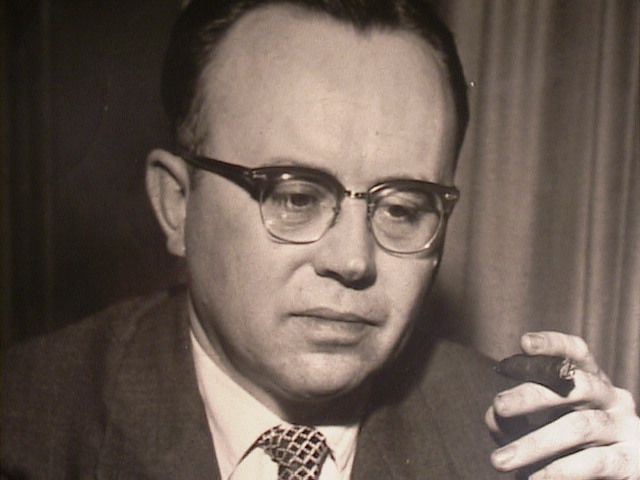
Russell Kirk (1918-1994)
In his twenty-nine books on politics, history, constitutional law, literature, social criticism, economics, and fiction, the shadow of the French Revolution and the loosening of the ideologues upon the world deeply haunted Russell Kirk.
Tellingly, his most important influence was Edmund Burke, the originator of conservatism in the post-medieval world and the most articulate spokesman against the French Revolution. Following the careful scholarship of Raymond Aron, Voegelin, Dawson, and Gerhart Niemeyer as well as the social criticism of Eliot, Kirk argued that one could define ideologies through three of its “vices.”
First, ideologies are political and secularized religions. They take with them the symbols and energy of religions, but they focus almost exclusively on the material and man rather than the spiritual and the Judeo-Christian God.
Solzhenitsyn’s 10 Ways Ideological Regimes Destroy You

The greatest murderer of the 20th century.
In some ideological regimes of the twentieth century, the killing was systematic. In others, it was merely random. Even a random thought, however, could lead to one’s death or the death of a loved one.
In Cambodia, to name one cruel example, the display of any emotions—all emotions being officially defined as “bourgeois”—resulted in immediate execution.
In the Soviet Union, to give another example, Lenin frequently sent messages to his secret police with such horrifying instructions as “To NKVD, Frunze. You are charged with the task of exterminating 10,000 enemies of the People. Report results by signal.” Usually, the secret police were given little time and no specific directions as to who the enemies of the people might be. They quickly rounded up 10,000 random persons so as to not violate their orders, and executed them.[1] One infamous story reports that Stalin often had the first person in a crowd who stopped applauding for one of his speeches immediately shot.
University Bookman News
This, this morning, from mighty Gerald Russello and the UNIVERSITY BOOKMAN:

Contributors in the News
The University Bookman congratulates Helen Andrews on her receipt of a prestigious Robert Novak Journalism Fellowship. Over the past few years, Helen has become a rising conservative star. She has written provocative, powerful pieces for the Bookman on subjects from the anti-suffragette movement to a sharp takedown of the work of Ta-Nehisi Coates, and has become one of our most widely read writers.
We extend our congratulations to Helen, and look forward to her future contributions to the Bookman and elsewhere (like her recent essay in American Affairs on J. S. Mill).
We also congratulate contributor Ashlee Cowles, whose Beneath Wandering Starswon the 2017 Colorado Book Award in the young adult category. The award was sponsored by Colorado Humanities.
Protesting Obama at Notre Dame in 2009
 I’m not at all sure why so many of my social media friends are offended or upset about graduation protests this year. I did everything I could (including adding a line or two to the main protest speech) when Father Miscamble organized an alternative commencement when Barack Obama spoke at Notre Dame.
When I graduated from the University of Notre Dame with my B.A. in 1990, I was furious that Bill Cosby was our speaker. I wish I had had the guts then to walk out.
Regardless, here was my report from the 2009 protest. Enjoy.
 Stormfields