Stormfields

Re-Thinking U.S. Foreign Policy

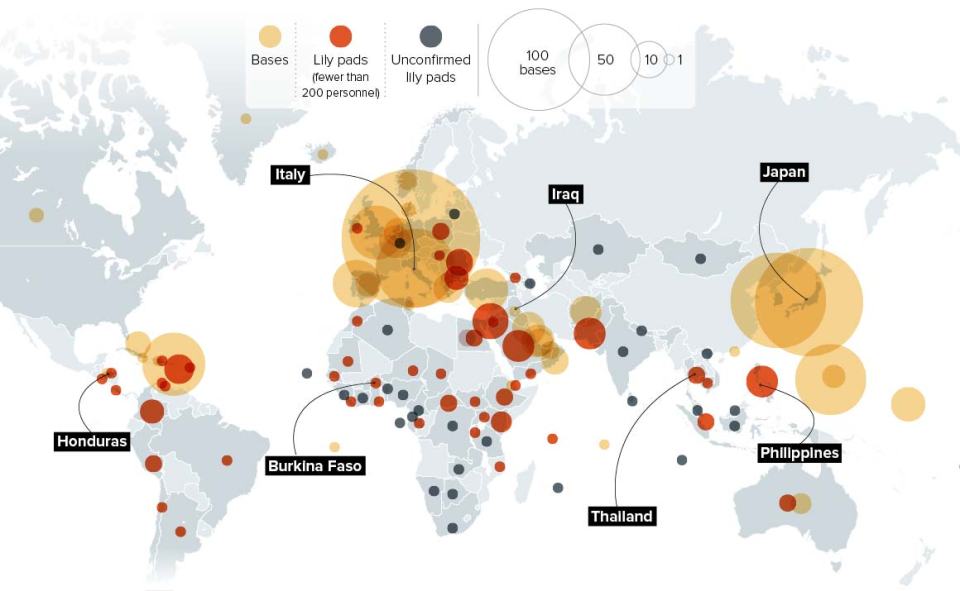
The U.S. military abroad, according to Politico Magazine:
backpage-11601

A year ago, on Facebook, I posted this as a way of thinking about Veterans’ Day:

It’s perfectly possible to be in favor of “isolation” and not be a fool.
It’s perfectly possible to love the Marines but fear the U.S. government.

It’s perfectly possible to believe in a strong military and not support empire.
A republic can never be and will never be compatible with an Empire.
A republic is secure and inward looking, an empire is arrogant and always demanding more.

For what it’s worth, I not only completely agree with what I wrote, but I think the moment in history–as in now–is much different than it was a year go.  Some mood has taken hold of many in the English-speaking world, recognizing, I think, that smaller units are more humane–generally–than larger units.  Brexit is a case in point, and Donald Trump’s election, or thus far, seems the same.  Please note, I’m not trying to make a statement either pro or con Brexit and Trump, only that each represents something changing dramatically in the western mindset.

Now, even leftists in California are talking seperation from the Union.  Generally, in the American experience, it’s the non-leftists who want to exit this or that.  It’s a good sign–at least to me–that the desire for separation is transcending simply ideological politics.

As of November 11, 2016, I do believe we’re at an important turning point in our history.  As Americans, I believe we’ve given enough to the world, especially  to the world that can afford to defend itself.  It’s time to bring every one back home. No more bases abroad (except where absolutely necessary).  I don’t mean to suggest that others haven’t done their fair share, only that we’ve been so committed to our adventures (and misadventures) overseas, that I think we’ve destablized the world as much as we’ve stablized it.  The same is true for our republic.

For too long, the wealthy of this country have stolen from those of us who work–through taxes and stimuli packages–to pay for the war machine that marches flabbily across the world.

Enough.  We are a republic, and our form of government was never intended to become an empire.  Indeed, we were founded as the most anti-imperial of all peoples.  We must re-embrace that tradition.  The moment is now.


[The above map is taken from: http://www.politico.com/magazine/story/2015/06/us-military-bases-around-the-world-119321]

A Primer on John C. Calhoun

[N.B.  The best person to read when studying Calhoun is Lee Cheek, an amazing scholar and equally gracious gentleman.]

jcc

Sam the Eagle. . . I mean, John C. Calhoun

Pre-Compromise of 1820 Nationalism.  Early Nationalist/War Hawk Calhoun: “Let it not be forgotten, let it be forever kept in mind, that the extent of the republic exposes us to the greatest of calamities—disunion,” Calhoun warned as Secretary of War in February 1817.  “We are great, and rapidly—I was about to say fearfully—growing.  This is our pride and danger, our weakness and our strength. . . . We are under the most imperious obligations to counteract every tendency to disunion. . . . Whatever impedes the intercourse of the extremes with this, the centre of the republic, weakens the union. . . . Let us, then, bind the republic together with a perfect system of roads and canals.  Let us conquer space.”

Post-1820 Decentralized Calhoun.  His theory (very Roman republican and very Calvinistic) as most fully expressed in The Disquisition on Government.

Read More

A Conservative Reflection on the 2016 Presidential Election

img_0910

My own Supergirl–worth more all the politicians in the world.


A brief version of this appeared at https://home.isi.org/nothing-has-changed-least-fundamentally.  A huge thank you to ISI for soliciting it.  Below is the director’s cut.

***

As another presidential election cycle comes to a conclusion and a new one already begun, it’s well worth thinking about the state of conservatism, its present and its future, as well as of the state of western civilization.  While this vicious, brutal, and malicious election cycle resembles many of the past elections in American history—especially those bitterly contested in and of 1824, 1876, and 2000—there are things about the 2016 cycle that make it interesting from a long-term perspective.  For one, the role of populism has made its striking mark across the political spectrum, perhaps in ways, at this moment, incalculable.  Perhaps more than anything else, personality mattered in the 2016 election.  Not character, but personality.  Not virtue, but smackdowns.

Read More

Today’s Absurdity: King Julien Joins Radiohead

Julien: If I, King Julien, that’s my name, had only two days to live, I would do all the things I always wanted to do.
Melman: Like what?
Julien: I’d become a professional whistler. I’m pretty fantastic right now, but I would do it professionally. Another thing I would do is invade a neighboring country, and force my own ideology on them, even if they didn’t want it.
–Madagascar 2
kinghead-001

My Conversation with President Mohler

Last week, I had the great privilege of speaking with President Albert Mohler (Southern Baptist Theological Seminar) about conservatism, Russell Kirk, politics, culture, and religion.  One of the best interviews I’ve ever had.  Thank you so much, Dr. Mohler!

screen-shot-2016-10-31-at-1-26-46-pm

http://www.albertmohler.com/2016/10/31/thinking-public-birzer/

The Bearable Lightness of the Middle Ages (Full Lecture)

worlds-best-stained-glass-windows-01-sized-from-architectural-digest

Photo courtesy of Architectural Digest

From crazy atheists to equally crazy fundamentalists, many have proclaimed the Medieval period as “dark and superstitious.”  They are either ignorant or evil (or, maybe both).  This lecture, viewed through the lens of Romano Guardini’s thought on unity, considers the role of that most medieval of documents, the Magna Carta.  And, finds it. . . good.  Very, very good.