

Wyndham Lewis to Russell Kirk, 1955
I’d not come across this letter before this afternoon. I found it in THE LETTERS OF WYNDHAM LEWIS, edited by W.K. Rose, page 563.
“My dear Kirk. First of all, let me thank you very much for your interesting article in Yale Review. I was delighted (though what the hell you meant by what I lacked for perfection was . . . !), and secondly, let me say how much I enjoyed your three books, sent me by Regnery. You’ re the latest, and by no means the least, of that brilliant group of Americans advocating that of all un-American things, the Traditional Spirit. Your praise of Edmund Burke is very much to my taste. Your witty prophecy of the immediate future should be enlarged.”–Wyndam Lewis to RAK, August 29, 1955.
Russell Kirk’s Six Tenets of Conservative Thought, 1953

Sketch by Anne-Catherine Froidmont.
- Belief that a divine intent rules society as well as conscience, forging an eternal chain of right and duty which links great and obscure, living and dead. Political problems, at bottom, are religious and moral problems. A narrow rationality, which Coleridge calls the Understanding, cannot of itself satisfy human needs. “Every Tory is a realist,” say Keith Feiling: “he knows that there are great forces in heaven and earth that man’s philosophy cannot plumb or fathom. We do wrong to deny it, when we are told that we do not trust human reason: we do not and we may not. Human reason set up a cross on Calvary, human reason set up the cup of hemlock, human reason was canonized in Notre Dame.” Politics is the art of apprehending and applying the Justice which is above nature.
- Affection for the proliferating variety and mystery of traditional life, as distinguished from the narrowing uniformity and equalitarianism and Unitarian aims of most radical systems. This is why Quintin Hogg (Lord Hailsham) and R.J. White describe conservatism as “enjoyment.” It is this buoyant view of life which Walter Bagehot called “the proper source of an animated Conservatism.”
- Conviction that civilized society requires orders and classes. The only true equality is moral equality; all other attempts at leveling lead to despair, if enforced by positive legislation. Society longs for leadership, and if a people destroy natural distinctions among men, presently Buonaparte fill the vacuum.
- Persuasion that property and freedom are inseparably connected, and that economic leveling is not economic progress. Separate property from private possession, and liberty is erased.
- Faith in prescription and distrust of “sophisters and calculators.” Man must put a control upon his will and his appetite, for conservatives know man to be governed more by emotion than by reason. Tradition and sound prejudice provide checks upon man’s anarchic impulse.
- Recognition that change and reform are not identical, and that innovation is a devouring conflagration more often than it is a torch of progress. Society must alter, for slow change is the means of its conservation, like the human body’s perpetual renewal; but Providence is the proper instrument for change, and the test of a statesman is the cognizance of the real tendency of Providential social forces.
Bernard Wall: Colosseum Will Not be a Polite Review
“The Colosseum will not be a polite review. We hold that in our time silence would be inexcusable; and our belief in what we intend to say is too sincere for us to sit back and pay scholarly compliments.”
Further, Bernard Wall argued, true Catholic scholars must no longer hide in the monasteries or accept penance in the desert. Instead, they must fight against the “shrieking contradictions of Capitalism, Bolshevism, Yogi, Democracy, Usury, Determinism, Freudianism, Starvation and Advocates of Poison Gas.”
The human person “has been defaced and is now exploited and commercialized.”
The world of the 1930s, shaped and delimited by the ideologues and their creation of the machine to mechanize man, offered only the false Manichean choice of “the sub-human mediocrity of the bourgeois world” and the false errors of the Bolshevists and Fascists, Wall argued. Because of the errors of the modern world, “crooks and demagogues like Stalin, Göring and Goebbels are enabled to exploit it.”
–Bernard Wall, Colosseum, 1934
The Revolution Began with A Fight Against Illegal Searches and Seizures
Whether left, right, middle, above, below–every single American should support Senator Rand Paul’s filibuster tonight. Republican, democratic. . . it just doesn’t matter. The U.S. government exists to protect us, not to spy on us.
The fourth amendment to the U.S. Constitution is pretty clear:
The right of the people to be secure in their persons, houses, papers, and effects, against unreasonable searches and seizures, shall not be violated, and no warrants shall issue, but upon probable cause, supported by oath or affirmation, and particularly describing the place to be searched, and the persons or things to be seized.
It’s also well worth remembering that our American Revolution began with a three-hour oration delivered by James Otis in February, 1761, protesting the unconstitutional British writs of assistance.
Here’s John Adams explaining the power of Otis’s protest:
But Otis was a flame of fire!—with a promptitude of classical allusions, a depth of research, a rapid summary of historical events and dates, a profusion of legal authorities, a prophetic glance of his eye into futurity, and a torrent of impetuous eloquence, he hurried away every thing before him. American independence was then and there born; the seeds of patriots and heroes were then and there sown, to defend the vigorous youth, the non sine Diis animosus infans. Every man of a crowded audience appeared to me to go away, as I did, ready to take arms against writs of assistance. Then and there was the first scene of the first act of opposition to the arbitrary claims of Great Britain. Then and there the child Independence was born. In fifteen years, namely in 1776, he grew up to manhood, and declared himself free.
Senator Paul is our flame of fire.

Kevin J. Anderson: Audible.com’s Deal of the Day
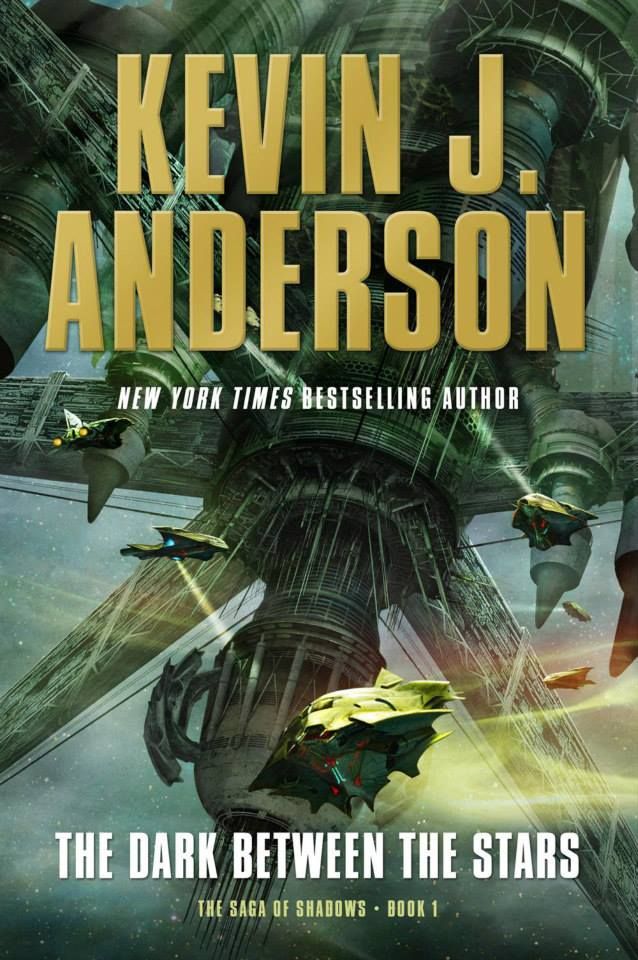
Nominated for a Hugo.
If you’re looking for dense, fascinating, and nuanced space opera, look no further than Kevin J. Anderson’s THE DARK BETWEEN THE STARS, recently nominated for a Hugo.
It’s also today’s Deal of the Day at Audible. Treat yourself.
Hitchcock’s ROPE: A Nietzschean Nightmare
Over at The Imaginative Conservative, I’ve started a series of reviews of Alfred Hitchcock movies. Here’s my first:
Enjoy!
 Stormfields