
My Interview with Tim Goeglein, RE: RUSSELL KIRK

I had a wonderful time last week, talking with the wonderful Tim Goeglein about Russell Kirk.
Thank you, Tim!
I thoroughly enjoyed our conversation, and I hope we can make it happen again. And, of course, it’s always great talking Kirk.
Part I:
Part II:
SAND 2: The Unadulterated Excellence of Sam Healy
SAND (Sam Healy), A SLEEPER, JUST AWAKE (Kscope; forthcoming, September 30, 2016). 9 tracks.
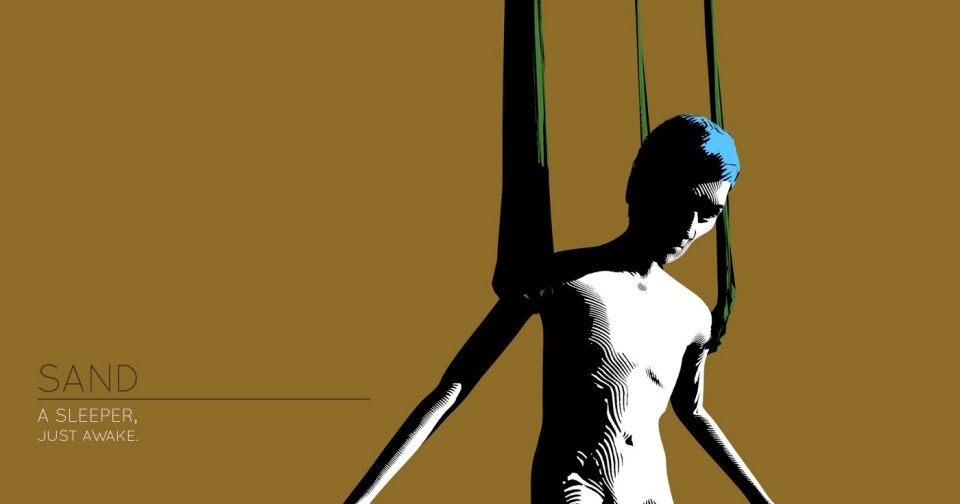
SAND, A SLEEPER JUST AWAKE (forthcoming from Kscope: September 30, 2016)
As much as I’d like to start with something artsy (the album deserves it), I’ll just be really, utterly, completely, and totally blunt. This album is extraordinary. After a summer of horrors and violence (not personally, but around the world), this album seems like the necessary art to calm the savage soul. I think this is, quite possibly, Healy’s best.
As I’ve written a number of times before when writing about Healy (solo) and about North Atlantic Oscillation, he does three things with unadulterated excellence.
First, his voice is always perfectly employed—as both an instrument and as an individual artist, letting his personality come through his nearly immaculate vocals. I think Healy’s voice and his use and control over his voice only get betters with each new album. As I’ve noted many times (so, apologies if you’re thinking, yes, we know!) my favorite voice in rock (in terms of beauty) is Susie Bogdanowicz’s from Glass Hammer. But, she has a soaring, church-like quality. In contrast, however, Healy’s is precise and always economical. It’s utterly earnest, while also being quite artistic.
Second, Healy knows exactly how to make an album flow. This is the ultimate goal—to my mind—in all art rock. Healy knows when to make things dance, and when to allow things to linger.
Third, Healy possesses an insanely cool way of mixing a cynical lyric with a wondrous (almost childlike, but certainly not childish) presentation. I’m not sure how he does this, but he does it very well.
My favorite songs—though I like all—are Initial (track 7) and Earth Mound Square (track 9). The transition from Embers to Initial is just jaw-droppingly good, and the woodwinds of Initial moved me so much that I actually had to stop and take a breath (I was hiking, with my headphones on, the first time I heard this).
For almost any reader of Progarchy, though, the key track will be the final one, Earth Mound Square, coming in at 10.5 minutes. In some crazily beautiful way, Healy combines dissonant Celtic strings with Reichian minimalism. The result is pure genius. I could easily and happily listen to a 20- or even 30-minute version of the final track.
Again, A SLEEPER, JUST AWAKE is extraordinary. While I’m more than eager to hear the new Glass Hammer and The Tangent, this album is, to my mind, the single finest album release of 2016, thus far. Frost*’s FALLING SATELLITES is its closest rival.
While the A SLEEPER, JUST AWAKE will appeal more to the art rock crowd than the progressive crowd, I hope that all will give it a listen and make a purchase or two. Healy deserves all the support we can offer. If you like early-period Thomas Dolby, late period Talk Talk, Kevin McCormick, Rhys Marsh, or Noflypaperhunting, this is must own. Actually, if you like music at all, A SLEEPER, JUST AWAKE is a must own.
Tending Our Own Garden: Rachel Gough

The beauty of the Gough women.
As you Stormfielders (thank you!) well know, I love–ok, this word isn’t even close to strong enough to describe how much I admire–the writings and work of my friend, Rachel Gough. Here’s her latest at Kindred Magazine.
RECENTLY I MET two young women farmers who are the granddaughters of farmers. Their own parents ‘escaped’ from farming with the idea that they were providing a better life for their children, but those children found their way back to their roots anyway.
There is something deeply satisfying about cultivating the earth, planting seeds and watching them grow, and harvesting your own food. It takes work, knowledge, care, and patience, and taps into the deep magic of the universe.
To read it all, please go here: https://kindredmag.com/2016/08/03/let-us-tend-our-own-garden/
Apocalypse ALWAYS
Image stol. . .borrowed from The Imaginative Conservative.
I will admit that this is possibly the weirdest thing I’ve ever written. But, I will also admit, I had a blast writing it. Thanks, as always, to Winston Elliott III and Stephen M. Klugewicz for encouraging my weirdnesses.
“What if the Apocalypse is not an event, but a long, drawn-out process?
What if rather than the drama of a rapture, we get the dread of a ceaselessly droning Ann Coulter or Rachel Maddow? What if the tyrants marked with the sign of the beast turn out to be elevator operators who love Muzak? What if the four riders of the apocalypse turn out to be Friends, MTV’s Real World, The O’Reilly Factor, and Game of Thrones? What if the Anti-Christ turns out to be the manager of Denny’s no. 3778, located in St. Paul, Minnesota? What if the seven seals turn out to be the best-selling paperbacks at the Detroit airport bookstore—that one right next to gate A37? What if the seven trumpets appear in some big band-polka revival group making its way through the charts of a Sheboygan, Wisconsin AM-station?No “Hand of God,” no “Jesus in the Sky,” no landing of the mothership, no dragon devouring the world. Instead, just slow, drawn out, painful, and seemingly inevitable decline.
“Help, I’ve fallen down, and I can’t get up!”
Calling All Literary Agents: A Book on Batman!
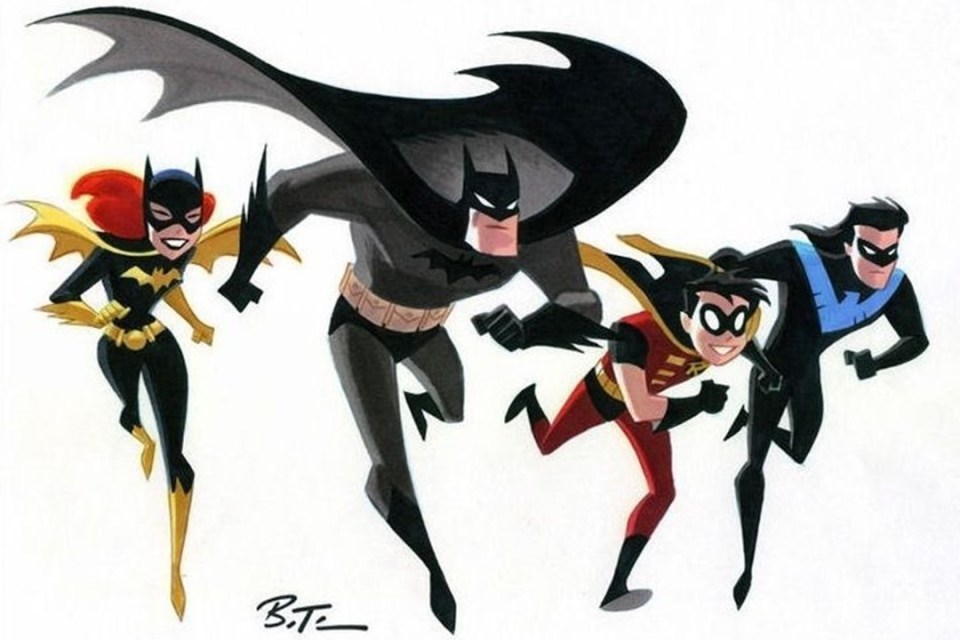
Bruce Timm’s Batfamily.
Book Proposal
To: XXXX
Date: 2016
Proposed Title: Batman: America’s Darkest Knight
By Bradley J. Birzer, Hillsdale College
Projected Book
Batman: America’s Darkest Knight will be an intelligent and lively but not academic book on the history and life of Bruce Wayne, Batman, 1939 to the present. Examining the manifestation of the Batman in every form of media—from comics to graphic novels to proper novels to television shows and motion pictures to video games—Batman: America’s Darkest Knight considers every aspect of the superhero, tying him not only to American culture but also to western mythology. The book will engage the reader by re-telling the history of the world over the last 80 years through the very American but tortured soul of Bruce Wayne.
Batman: America’s Darkest Knight will also connect Batman to American literature and, especially, to the pulp culture of the 1930s and 40s.
Length
Ca. 200,000 words.
Sources
Everything dealing with Batman, including the personal correspondence and letters of his various creators and writers over the years. Interviews, etc.
Completion Date
Spring 2018
Why Batman?
Though he’s as American as Natty Bumppo or Huck Finn, Batman could never have come into being in the wilds of the Catskills or on the seemingly unending Mississippi. Only the nightmarish and shadowed scapes of post-nineteenth century urban America could allow a Batman to become the darkest and yet most heroic of American literary characters over such a long and continuous period of time. Well after Cooper’s frontier novels have been relegated to the dustbins of used bookstores and Huck Finn is only taught in high schools that fail to heed the political correctness of the moment, the character of Batman will still speak to all of us. For all intents and purposes, his city, Gotham, is every American city. I write all of this not so much with glee as much as I do with simple certainty. The early American frontier of Cooper’s day will never return and neither will the social concerns that animated Twain. America, however, will continue to urbanize and grow up, ever higher, rather than out. As such, Batman will continue to speak to us in a variety of voices, but also, paradoxically, in the one voice. He has become, arguably, the single most important symbol of a post-frontier and post-rural America.
And, yet, like the complex and nuanced heroes of Cooper’s and Twain’s imaginations, Batman is much more than a mere man. He is a symbol, a legend, and a myth. As such, nearly innumerable elements come together to make up his character. He is aristocrat, vigilante, policeman, holy avenger, social worker, detective, spy, and vampire hunter. Even from his earliest origins, he was equally St. Michael, King Leonidas, Judah Maccabees, Aeneas, King Arthur, Leonardo DiVinci, Thomas Jefferson, C. Auguste Dupin, Abraham Van Helsing, Sherlock Holmes, Zorro, The Phantom, Doc Savage, Douglas Fairbanks, and The Shadow. He is the Archangel Raphael as well as the famed but mysterious cowboy Shane, the aristocrat who properly protects and serves the poor and abused.
Since Bob Kane and Bill Fingers first created him in early 1939, Batman’s popularity has grown steadily, if not always spectacularly. During the so-called Golden Age of comics, the 1930s and 1940s, Batman used a gun, avenged crimes, and defeated monsters. True, as his publishers could not decide if Batman scared children too much, they added a colorful and young character, Robin, to accompany him. Though of equally tragic origins, Robin (Richard “Dick” Grayson) brought a character with which a younger audience could identify. Still, the Dark Knight remained rather dark, even if accompanied by a colorful sidekick who might very well invoke the cultural memory of Robin Hood. In the era of the Silver Age (early 1950s through 1970 or so), Batman became an ironic and comic figure, a clown, battling bizarre extraterrestrials and yelling things such as “Old Chum.” A very popular counter-culture T.V. Series, Batman, ruled the airwaves from 1966 to 1968, defining a campy caped crusader for an entire generation. Over-the-top action as well as overly dramatic colors, sets, and sound effects turned Batman into a buffoon, but, ironically, also into a tangible revolutionary comment on the traditions of the normal, conformist American middle-class life prior to the radical cultural revolutions of that decade. Beginning in 1969, writers for DC Comics brought the golden age Batman—the darkest of America’s knights—back, ushering in what is remembered as the “Bronze” age of comics, lasting until the mid-1980s.
In the middle of the decade of Reagan, Blade Runner, and Rush, writers such as Alan Moore and Frank Miller produced a new medium for the comic heroes and anti-heroes of the previous four decades, the graphic novel, a thing that is neither novel nor comic, but a third thing altogether. Batman, not surprisingly, fit the format well, once again becoming even darker than before, embodying not just American aristocracy at its best, but also embracing a counter-ideological ethos, defending the weak and the innocent from the corruption and abuse of the elites. Tellingly, Miller even named his first great graphic novel, The Dark Knight Returns, featuring a wizened and bitter Bruce Wayne, reclaiming the mantle of the Bat to combat psychologically-deranged predators as well corrupt police forces and a corrupt U.S. Government now protected by an unthinking neoconservative warmonger, Superman. Writer and artist Mark Voger has properly labeled this fourth age of comics, “The Dark Age.”[1]
Since first appearing in 1939 in comics, Batman has remained not only a mainstay of the comic book world, but he has also done well in novels, comic strips, television shows (animated as well as live action), movies (again, animated as well as live action), and video games. Action figures of Batman and his many companions and foes, as well as toys of the Batcave and of the numerous Batmobiles and Bat-vehicles have sold consistently well for the past quarter of a century well. When I recently asked a class of upperclassmen—all excellent and, in terms of intelligence, quite extraordinary—a series of questions about Bruce Wayne, the students could answer every single question. When I asked similar questions about Natty Bumppo and Huck Finn, the same students were stumped and hesitant, though they had certainly read and studied Cooper and Twain, often in great detail. Simply put, this reveals how much of an American icon Wayne/Batman has become. Though I asked these questions of students at a prestigious American liberal arts college, I am certain that I would find similar answers and a similar knowledge base among a group of shoppers at Wal-Mart or among hipsters at the local coffee shop or among parishioners at the local Catholic Church.
Author: Bradley J. Birzer
I hold the Russell Amos Kirk Chair in American Studies and am Professor of History at Hillsdale College, Michigan. I proudly serve on the boards of the Free Enterprise Institute and The Center for Cultural Renewal. I am also happily a “Fellow” and/or “Scholar” with the Reagan Library, the Foundation for Economic Education, the Intercollegiate Studies Institute, The McConnell Center for Public Policy, the Russell Kirk Center for Cultural Renewal, and the Center for Economic Personalism (Brazil). In 2010, I co-founded The Imaginative Conservative website, and, in 2012, I co founded Progarchy.com, I also write for Ignatius Insight, Catholic World Report, and The American Conservative. In 1990, I earned my B.A. from the University of Notre Dame, and, in 1998, I earned my Ph.D. from Indiana University. For the 2014-2015 school year, I had the wonderful honor of being the “Scholar in Residence” and “Visiting Scholar in Conservative Thought and Policy,” University of Colorado-Boulder.
My books have all sold very well and have been critically acclaimed:
- Russell Kirk: American Conservative (2015)
- Neil Peart: Cultural (Re)Percussions (2015)
- American Cicero: The Life of Charles Carroll (2010)
- Sanctifying the World: The Augustinian Life and Mind of Christopher Dawson (2007)
- R.R. Tolkien’s Sanctifying Myth (2003)
Why me?
My maternal grandparents—whom I loved dearly—bought me my first comic book sometime in 1971 in a “Five and Dime” store in Hays, Kansas. I was three. I’ve loved Batman ever since and have followed him as faithfully as money and circumstances would allow for well over four decades. A lover of fiction and history, I have never shied away from any form of popular culture. Batman has struck me for a very long time as the quintessential American character. As a professional biographer, I am most interested in the very essence of a person. Bruce Wayne widens the imagination and lets us explore realms and depths largely impossible elsewhere in the American mythos.
[1] Mark Voger, The Dark Age: Grim, Great, and Gimmicky Post-Modern Comics (Raleigh, NC: Twomorrows, 2006). Not surprisingly, fans dispute the “ages” of comics, and, while a number of fine schemes have been put forward, the Gold, Silver, Bronze, and Dark Ages have become the most acceptable established canon. Paul Levitz’s massive series based on the eras in DC Comics history has served to solidify this timing/scheme.
Celebrating Homer: A Divine Shining — The Imaginative Conservative

The question of Homer’s existence is a little like the question of God’s. There, unquestionably, like the universe, are the Iliad and The post Celebrating Homer: A Divine Shining appeared first on The Imaginative Conservative.
via Celebrating Homer: A Divine Shining — The Imaginative Conservative
Literature & Politics: A Little More than Kin and Less than Kind — The Imaginative Conservative

Among other disasters, Neville Chamberlain is famous for a particularly ill-chosen quotation from Shakespeare. In September 1938, he announced his Munich conference The post Literature & Politics: A Little More than Kin and Less than Kind appeared first on The Imaginative Conservative.
via Literature & Politics: A Little More than Kin and Less than Kind — The Imaginative Conservative
The Return of “Enemies of the Permanent Things” — The Imaginative Conservative

Of all Russell Kirk’s books, Enemies of the Permanent Things has the oddest history. Its origins were in the Darcy Lectures that The post The Return of “Enemies of the Permanent Things” appeared first on The Imaginative Conservative.
via The Return of “Enemies of the Permanent Things” — The Imaginative Conservative
RUSSELL KIRK Nominated for Paolucci Book Award
 I’m thrilled that RUSSELL KIRK: AMERICAN CONSERVATIVE has been nominated as a finalist for the Paolucci Book Award.
Lexington, KY-University Press of Kentuckybiography, Russell Kirk: American Conservative by historian Bradley J. Birzer has been named a finalist for the Henry and Anne Paolucci Book Award given by the Intercollegiate Studies Institute. ISI is a non-profit educational organization devoted to the promotion of conservative thought on college campuses. It was founded in 1953 by Frank Chodorov with William F. Buckley Jr. as its first president. The award honors the book that best advances conservative principles.
Learnliberty.org, my first post. The Founding and Natural Rights
Extremely proud to be published at learnliberty.org. My thoughts on the libertarian element of the American founding.
Historically, one can also state that the American founding period (1761 through roughly 1806) represents one of the finest attempts in the history of the world to allow classical liberalism to flourish at any level beyond something particularly local.
Not that the United States of America was perfect. Far from it. Its sins and failings are as powerful and as depressing as the sins and failings of any political entity in history. And yet, while the mistakes the United States (as a government and as a people) has made are atrocious, the successes of the republic are equally strong.
The Freedom of a Life: A Hayekian View

Here’s the main problem for scholarship dealing with free will—it’s outrageously messy. For a moment, imagine how many people had to come together just for you to be here. You’re sitting (presumably) there reading this. Maybe you’re at the office, maybe you’re sitting in your lounge chair or maybe you’re at the coffee shop. Try to calculate how many people had to come together—biologically, to pro-create—for you to be here, wherever you are as you read this…. You have your folks, their folks, and their folks. Beyond that, we start getting fuzzy. And, why not—who in normal life keeps track of family beyond three or four generations? It becomes not just fuzzy but actually hazy after our great-grandparents. Regardless, every one of them had to make decisions for you to be reading this now, to exist at all. All those decisions by all those people. How many corners turned or not? How many decisions made or not? Was the act of coming together rational or purely passionate? Or, some mixture of each? How much gumption was there? Did he ask her to the dance, or did he freeze at the moment? Most likely, the former if you’re reading this. Did she drop her handkerchief on purpose, or was it purely accidental?
My very Hayekian take on life. Over at The Imaginative Conservative.
Conservatism Means Conservation — The Imaginative Conservative

Today’s offering in our Timeless Essay series affords readers the opportunity to join Roger Scruton as he considers the conservative nature of environmentalism. The post Conservatism Means Conservation appeared first on The Imaginative Conservative.
via Conservatism Means Conservation — The Imaginative Conservative
 Stormfields