
H301, Founding of the American Republic: Syllabus, 2014
Syllabus, H301: Founding of the American Republic
Spring 2014
Instructor: Brad Birzer
email: bbirzer@hillsdale.edu
Office: Delp 403; Office hours: TBA
Classes Meet: Lane 333, Mondays, Wednesdays, Fridays, 10-10:50AM
A standing military force, with an overgrown Executive will not long be safe companions to liberty. The means of defense against foreign danger, have always been the instruments of tyranny at home. Among the Romans it was a standing maxim to excite a war, whenever a revolt was apprehended. . . . armies kept up under the pretext of defending have enslaved the people.–James Madison, June 29, 1787, debate at the Constitutional Convention, Philadelphia.
Required Readings
- Edmund Morgan, Birth of the Republic (3d or 4th edition is fine—kindle or tangible)
- Multiple Documents: You can most of the documents, in several formats, at the Online Library of Liberty (http://oll.libertyfund.org).
- Handouts, timelines, quotes, and misc. items.
- Notices, additional documents, etc. for class at: https://stormfields.wordpress.com. See below for list of documents to use.
Grading
- Semester-long Research Paper: 30%
- Midterm Examination: 30%
- Final Examination: 40%
Research Paper
Worth 30% of your grade, your research paper can cover any topic—biography, expedition, settlement, military battle or campaign, Congress, administration, idea(s), debate, etc.—between 1754 and 1807. Final paper, due to me no later than April 4, 2014, 5pm. The paper should be 10-12 pages in normal 12-point font (Cambria, Times, etc.), double spaced, footnoted, and with 1 inches margins on the top, bottom, and sides. For footnote format, please use either Turabian or Chicago Manual of Style formats. I encourage you to own a (real; tangible—not just e-version) of a good dictionary and thesaurus. As to computer programs/apps, I suggest Endnote as the best for bibliographical reference and formatting, and Scrivener as the best writing program. Our library possesses excellent primary document collections, on the shelves as well as online. While I do not mind you using secondary sources, I would encourage you strongly to use as many primary sources as possible. Frankly, it is very difficult to find satisfactory secondary sources on almost any aspect of the founding, as almost every author comes at the topic with some agenda. Every writer (especially American writers)—left, right, above, below, next to—desires to co-opt and use the founders for personal goals. Hence, the desire to teach and learn almost exclusively from primary documents.
Laptops and other electronic note taking devices
You’re more than welcome to use a laptop or equivalent to take notes during class. Please, however, do not turn on the wireless or anything to connect to the world outside of this classroom! Thank you.
Documents to read before midterm:
- John Adams, Dissertation on Feudal and Canon Law
- Cato’s Letters: 15, 17, 18, 25, 27, 31, 35, 42, 59, 62, 66, 84, 94, 106, 114, 115
- Thomas Gordon, “A Discourse of Standing Armies”
- Demophilus, “The Genuine Principles of the Ancient Saxon, or English Constitution”
- Addison, Cato: A Tragedy
- Hamilton, “Remarks on the Quebec Bill”
- Dickinson, Letters from a Pennsylvania Farmer: 1, 3, 8-10, 12
- Edmund Burke, “Speech on American Taxation”
- Edmund Burke, “Speech on Conciliation with the Colonies”
- Samuel Sherwood, “The Church’s Flight into the Wilderness”
- CX Letters (will be emailed to you)
- Articles of Confederation
- Declaration of Independence (Jefferson’s version; will be emailed to you)
Documents to read before the final:
- George Washington, “Circular to the States” (1783)
- Northwest Ordinance, Articles 1-6
- Farrand, ed., Records of the Federal Convention: May 29-June 8, June 18, June 26, June 28-29, July 26, August 7-9, August 13-14, August 21-22, August 30-31, September 17
- Federalist Papers: 1, 10, 39, 45-51, 63, 70, 78, 84-85
- Anti-Federalist Papers:
- James Wilson, “Speech to the Pennsylvania Convention” (December 1787)
- John Dickinson as “Fabius,” letters 10-3
- Noah Webster, “A Citizen of America”
- Tench Coxe, “An American Citizen”
- James Wilson, “Of the Law of Nature”
- James Wilson, “Of the Natural Rights of Individuals”
- Burke, “Reflections on the Revolution in France,” pp. 87-176
- Burke, “Further Reflections on the Revolution in France,” (1791), pp. 75-124, 160-201
- George Washington, First Inaugural Address
- George Washington, “To the Hebrew Congregation in Newport”
- George Washington, “To the Roman Catholics”
- George Washington, Farewell Address
Dates of the Semester
1. January 15-17
2. January 20-24
3. January 27-31
4. February 3-7
5. February 10-14
6. February 17-21
7. February 24-28; Midterm: Feb. 28
8. March 3-7 (Vernal Frolick Break—March 7-16)
9. March 17-21
10. March 24-28
11. March 31-April 4 (Research Paper due—April 4, 5pm)
12. April 7-11
13. April 14-18 (April 18 (noon)-April 21: Easter Break)
14. April 22-25
15. April 28-29
Russell Kirk: To What Truths
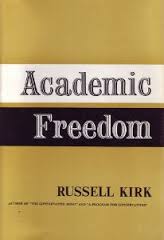
To what truths, then, ought the Academy to be dedicated? To the proposition that the end of education is the elevation of reason of the human person, for the human person’s own sake. To the proposition that the higher imagination is better than the sensate triumph. To the proposition that the fear of God, and not the mastery over man and nature, is the object of learning. To the proposition that equality is worth more than quantity. To the proposition that justice takes precedence over power. To the proposition that order is more lovable than egoism. To the proposition that to believe all things, if the choice must be made, is nobler than to doubt all things. To the proposition that honor outweighs success. To the proposition that tolerance is wiser than ideology. To the proposition, Socratic and Christian, that the unexamined life is not worth living. If the Academy holds by these propositions, not all the force of Caesar can break down its walls; but if the Academy is bent upon sneering at everything in heaven and earth, or upon reforming itself after the model of the market-place, not all the eloquence of the prophets can save it.
Source: Russell Kirk, Academic Freedom: An Essay in Definition (Chicago, IL: Regnery, 1955): 190-191.
Schedule: First Week of Classes
Date: August 25, 2013
Dear Students,
With apologies, I will be out of town today (August 25) through Friday (August 30) afternoon. I’m traveling on college business, just in case you thought I might be AWOL. So. . . .
If you’re taking me for H104 (Heritage), you will still be meeting on Wednesday, August 28 (Feast of St. Augustine) in the assigned classroom. My wife, Dr. Dedra Birzer, will hand out the books and the syllabus. And, she’ll smile and say brilliant things.
If you’re taking me for H495, Christian Humanism, we’ll meet for the very first time, Monday, September 2, normal time, normal place. Please have finished CANTICLE FOR LEIBOWITZ by our first class meeting.
Should you need anything immediately, the ubercool Delp Hall Tzarina, Denise Nivison, can get a hold of me.
Thanks and God bless,
Brad Birzer
University Bookman, Winter 1984 (Full)
The Winter 1984 edition of Russell Kirk’s journal, The University Bookman. This appears to be a double issue, complete with two poems, a discussion of the Socratic method of teaching, and several interesting book reviews. Enjoy.
University Bookman, Spring 1966 (full issue)
And, the latest scan of the University Bookman, founded and edited (until his death in 1994) by Russell Kirk.
Highlights of this issue: the mixed blessing of the AAUP; the meaning of fiction, and the “Unweaned Colossus.”
Enjoy.
She Dances
Her body rests nearby. My home, what would have been her home, is the closest one to her resting spot. The ground in which she is buried is holy ground. Sanctified, a stone sits; upon it is engraved her name, a date, a descriptive, a verse from St. John, a cross, a harp, and a rose. Rocks from various regions of God’s country (the American West), shells from Lake Michigan and the Pacific, a statue of His mother, a figurine of Briar Rose, and a multitude of flowers watch over her grave.
A shrine, this is hallowed ground. I touch the stone everyday. “Hail Mary, full of grace. . .”
Her soul is as alive as her body is dead, as the stone is cold. She dances, you know. She dances with the Lord, she dances with His Mother, she dances with His angels, she dances with her grandfather and all those who came before her. Her great grandmother even greets her every morning with sugar-free candy, a hug, and a Germanic “gella.”
I’ve seen my Cecilia Rose–in imagination and in prayer–many times. She would be two years old this morning, had she lived in this world. God had other plans for her.
What age is a dancing spirit in heaven? I have no idea. In my mind and in my soul, though, she appears as a 6 or 7 year old.
She’s delightfully beautiful. Mischievous, to be sure. She’s come up and tagged me on the back, laughed, and run away. She’s hid behind the hem of God’s robes and smiled at me, confidently. She’s glanced at me, faerie like, from behind and in between flowers blessedly left behind by a previous owner of our property.
I’ve also seen in her the intensity of my oldest son, Nathaniel; I’ve seen in her the warm smile and caring of my daughter, Gretchen; I’ve seen in her the playful and mysterious look in the eyes of my daughter, Maria Grace; I’ve seen in her the open emotions in the running welcome of my son, Harry; I’ve seen in her the piercing joy in the giggle of my youngest son, John; and I’ve seen in her the unrelenting grace in the strength of my wife, Dedra.
Every vision, every touch, every thought of her is a gift beyond measure. Every glimpse of her in the life of one of my living children and in my wife is an insight into what is eternally true.
And yet, despite all of this, and the confidence I have that she resides in her heavenly home and with her heavenly Father, the anguish continues, the intellect questions, and the faith wanders, sometimes near, sometimes far.
How does one cope with the death of a daughter? How does one accept that God asks us to bring a soul into the world, only to take her before she can breathe her first breath, only to be strangled by the very thing that gave her life for nine months?
Dear God, why would you do this? Dear God, why would you have my wife bring into this world the child she carried within her for nine months only to keep her for Yourself? Dear God, you are taking care of my daughter, right? Right?
Though I do not fully understand–nor pretend to–Your reasons, You promise to bring all things to right order, to right all wrongs, to heal all ills. Dear God, I pray Cecilia Rose has not been left behind. I trust You keep her safe, I trust You love her, I trust You let her dance, I trust You let her sit on the velour-panted legs of my grandmother. (Grandmother, I trust you share your sugar-free candy with my little not-left-behind one. Grandpa, I trust you walk with this blue-eyed one, hand in hand, named after your sister, as I assume you know, who also left this world at an age too young. By the way, I miss you two as well.)
Yes, the doubts still linger, the pain still stabs. . . . but each comes and goes less frequently than before. When they come, they come just as strong as they’ve always come; they hurt as much as they’ve always hurt. But the coming is less, the hope is greater.
I will trust You. For, have I mentioned? I’ve seen her. She’s delightfully beautiful. Mischievous, to be sure. And, have I mentioned? She dances.
Someday, I pray, she will dance with me.
Cather, “On the Art of Fiction,” 1920.
One is sometimes asked about the “obstacles” that confront young writers who are trying to do good work. I should say the greatest obstacles that writers today have to get over, are the dazzling journalistic successes of twenty years ago, stories that surprised and delighted by their sharp photographic detail and that were really nothing more than lively pieces of reporting. The whole aim of that school of writing was novelty—never a very important thing in art. They gave us, altogether, poor standards—taught us to multiply our ideas instead of to condense them. They tried to make a story out of every theme that occurred to them and to get returns on every situation that suggested itself. They got returns, of a kind. But their work, when one looks back on it, now that the novelty upon which they counted so much is gone, is journalistic and thin. The especial merit of a good reportorial story is that it shall be intensely interesting and pertinent today and shall have lost its point by tomorrow.
Art, it seems to me, should simplify. That, indeed, is very nearly the whole of the higher artistic process; finding what conventions of form and what detail one can do without and yet preserve the spirit of the whole—so that all that one has suppressed and cut away is there to the reader’s consciousness as much as if it were in type on the page. Millet had done hundreds of sketches of peasants sowing grain, some of them very complicated and interesting, but when he came to paint the spirit of them all into one picture, “The Sower,” the composition is so simple that it seems inevitable. All the discarded sketches that went before made the picture what it finally became, and the process was all the time one of simplifying, of sacrificing many conceptions good in themselves for one that was better and more universal.
Any first rate novel or story must have in it the strength of a dozen fairly good stories that have been sacrificed to it. A good workman can’t be a cheap workman; he can’t be stingy about wasting material, and he cannot compromise. Writing ought either to be the manufacture of stories for which there is a market demand—a business as safe and commendable as making soap or breakfast foods—or it should be an art, which is always a search for something for which there is no market demand, something new and untried, where the values are intrinsic and have nothing to do with standardized values. The courage to go on without compromise does not come to a writer all at once—nor, for that matter, does the ability. Both are phases of natural development. In the beginning the artist, like his public, is wedded to old forms, old ideals, and his vision is blurred by the memory of old delights he would like to recapture.
The Borzoi, 1920

Cather and the Perfect Definition of Christian Humanism
I don’t myself think much of science as a phase of human development. It has given us a lot of ingenious toys; they take our attention away from the real problems, of course, and since the problems are insoluble, I suppose we ought to be grateful for distraction. But the fact is, the human mind, the individual mind, has always been made more interesting by dwelling on the old riddles, even if it makes nothing of them. Science hasn’t given us any new amazements, except of the superficial kind we get from witnessing dexterity and sleight-of-hand. It hasn’t given us any richer pleasures, as the Renaissance did, nor any new sins – not one! Indeed, it takes our old ones away. It’s the laboratory, not the Lamb of God, that taketh away the sins of the world. You’ll agree there is not much thrill about a physiological sin. We were better off when even the prosaic matter of taking nourishment could have the magnificence of a sin. I don’t think you help people by making their conduct of no importance – you impoverish them.

–Godfrey St. Peter in Willa Cather, THE PROFESSOR’S HOUSE (1925).
University Bookman, Summer 1980 (full version)
 Kirk’s powerful journal, THE UNIVERSITY BOOKMAN, is now expertly edited by Gerald Russello.
This issue–Vol. 20, No. 4–is reprinted here with kind encouragement from Annette Y.C. Kirk.
Historian John Lukacs wrote the lead article. Other pieces deal with the intelligentsia, political novelists, and western science.
The whole issue is a treat, to be sure. Humane and wise.
Proud to be in Contemporary Authors

Actually, referencing No. 288. But, Google has this picture, so I grabbed it.
Just found this a few minutes ago. Ego is very, very happy at the moment.
In 2002, Birzer published J.R.R. Tolkien’s Sanctifying Myth: Understanding Middle-Earth. Birzer’s study examines the work of J.R.R. Tolkien in light of his Catholic beliefs. In a laudatory review in Modern Age, James E. Person, Jr., found that “Dr. Birzer gives every indication of having read and ably apprehended everything of significance written by and about Tolkien, and that is no small accomplishment.” Person went on to explain that, “as Birzer demonstrates, while many people of every religious persuasion have enjoyed The Hobbit (1937) and The Lord of the Rings, there is something more than a deeply moving read in Tolkien’s complex mythology of Middle-earth, with its men, wizards, elves, orcs, dwarves, and other creatures.” According to Person, “This becomes startlingly plain when these works are examined within the fuller context of Tolkien’s letters, The Silmarillion (1977), and his little-known, unpublished sequel to the Ring trilogy, an unfinished fragment called ‘The New Shadow,’ along with several other works.”
Other reviewers were likewise impressed with J.R.R. Tolkien’s Sanctifying Myth. Ray Olson, writing in Booklist, called the book “essential reading for all Tolkien enthusiasts” and declared that “Birzer reveals The Lord’s Catholicism in five riveting chapters.” A reviewer for Publishers Weekly considered the book “a fine tribute” to Tolkien and observed, “Birzer is a fine writer who does a wonderful job of integrating primary sources such as letters … [and] he also includes glimpses of unpublished materials.” In the aforementioned review for Modern Age,Person stated, “Readers of Birzer’s fine study will see with fresh eyes how Tolkien’s legendarium of Middle-earth likewise restores myth to its rightful place, not as a purveyor of ‘lies breathed through silver,’ but as a conduit of truth. J.R.R. Tolkien’s Sanctifying Myth is rounded out by a well-selected bibliography of secondary sources, with most of the entries citing fairly modern studies of Tolkien’s works.” Person deemed the book “a ‘must-have’ for any student or interested reader seeking to understand more fully perhaps the most remarkable writer of the twentieth century–and not only to understand, but to enjoy: a sterling accomplishment for any writer.”
Birzer told CA: “Words–as definitions, as concepts, and as art–have intrigued me since early grade school. Much of this early love stems from a religious (specifically, Roman Catholic) upbringing–especially with God speaking the universe into existence, Christ as the Word Incarnate, etc. At age ten, I also read J.R.R. Tolkien’s Ainulindalë, the story of creation in The Silmarillion, repeatedly. Again, the notion of words and song as power captivated me, and Tolkien’s ideas continue to influence me to this day. Indeed, I can’t read Genesis without imagining the song of Ilúvatar. After devouring Tolkien as well as Ray Bradbury, I tried rather unsuccessfully to write a number of fantasy stories, but I realized very quickly a love for nonfiction. So, while I read all the science fiction and fantasy I could, I began writing nonfiction. I wrote my first voluntary research paper for my fifth-grade teacher. He had been a Korean War vet, and I wrote on the European theater of World War II. Other research papers followed: on the Middle Ages, NASA, the history of Hong Kong, and anything else that interested me. I found that I liked research as much as I enjoyed writing.”
When asked who or what influences his work, Birzer explained: “The three authors I hope have influenced me most are J.R.R. Tolkien, T.S. Eliot, and Joseph Pearce. Tolkien, of course, for his imagination and voice. He’s a master of each, and, as his obituarist wrote, ‘he had been inside language.’ Comparable only to Tolkien in his understanding and employment of words is T.S. Eliot. Taken together, The Wasteland, The Hollow Men, Ash Wednesday, and the Four Quartets serve as modernity’s Divine Comedy. Eliot also understood the continuity of all traditions and all voices in our own creations. Finally, our best contemporary biographer is the tenacious Joseph Pearce. No one, I believe, has the ability to get into the mind (and soul) of his subject better than Pearce. Endowed with this unique insight, Pearce always has something of importance to write and to renew our hope in virtue and a life well lived.
“Generally, I like to immerse myself in a topic before I write on it. Or, more typically, I’ve already been immersed in some topic when I decided to write on it. I’ve wanted to write on Tolkien since I first encountered his work in 1977. Though I’d heard of Christopher Dawson, I didn’t read him until Thanksgiving 2001. At the moment I finished his The Judgment of Nations, I knew I wanted to write him. Other subjects, such as the intellectual biography of Charles Carroll of Carrollton, came by invitation. Once I’ve decided on a subject, though, I try to find every primary source possible, in libraries, periodicals, and archives. I also try to avoid secondary sources until after I’ve completed my research. When researching, my goal is to leave no page unturned, to leave no source undiscovered, and to have found something that no other writer has yet seen.
“The most surprising thing I have learned as a writer is how indescribably satisfying and spiritual a good day of writing is.” Birzer then explained that his favorite book that he has written isSanctifying the World “because of the necessity of understanding Dawson’s arguments about the meaning of the human person, about the nature of good and evil, and about community as we continue through the twenty-first century.”
“I hope and pray that every one of my books will capture and promote the dignity of each individual human person in creation–past, present, and future.”
FURTHER READINGS:FURTHER READINGS ABOUT THE AUTHOR:
PERIODICALS
- Booklist, September 15, 2002, Ray Olson, review of J.R.R. Tolkien’s Sanctifying Myth: Understanding Middle-Earth, p. 194.
- Choice, May, 2003, J.R. Christopher, review of J.R.R. Tolkien’s Sanctifying Myth, p. 1549.
- Modern Age, summer, 2003, James E. Person, Jr., “The Transcendent in Tolkien,” review of J.R.R. Tolkien’s Sanctifying Myth, p. 274.
- National Review, April 7, 2008, James E. Person, Jr., “The Full History,” review of Sanctifying the World: The Augustinian Life and Mind of Christopher Dawson, p. 54.
- Publishers Weekly, October 28, 2002, review of J.R.R. Tolkien’s Sanctifying Myth, p. 67.
- Reference & Research Book News, February 1, 2003, review of J.R.R. Tolkien’s Sanctifying Myth, p. 229.
Source Citation (MLA 7th Edition)
“Bradley J. Birzer.” Contemporary Authors Online. Detroit: Gale, 2010. Literature Resource Center. Web. 10 Aug. 2013.
Further thoughts on the Massacre of Japanese Civilians, August 1945
Thanks to Winston Elliott III for reposting my three-year old piece on American crimes against Japanese civilians. I must admit, I never cease to wonder at the responses that come as a defense of U.S. actions. The only possible defense is utilitarian, a calculation that sets Americans against Japanese civilians. The biggest defense is that “we had to do it; my dad (insert any person–uncle, brother, grandpa) would’ve been one of the 1,000,000 soldiers who would die on the beaches of Japan.” Well, this is quite possible. Lots and lots of good men died in World War II. Checkout the invasion of Normandy beach. I can’t confirm or deny that some person important to you wouldn’t have died. But, I can say two things. 1) No major ethical thinker (Socrates, Hillel, or Jesus, to pick three somewhat haphazardly) in western civilization would ever condone the intentional slaughter of innocents, preemptively or not. If you do condone the slaughter of innocents, you can’t consider yourself civilized in any meaningful way. 2) I’m not a pacifist at all. I would (I hope) have stood with Leonidas at the Gates of Fire, Cato the Younger against Caesar, Alfred the Great against the Vikings, Harold of Hastings against William the Bastard, the Anglicans at York singing the Te Deum as the Roundheads bombarded them in the cathedral, John Dickinson and his militia in Delaware, Crazy Horse at Little Big Horn, and William H.L. Wallace at Shiloh, and next to Maximilian Kolbe at Auschwitz. But, murdering women and children with insane superweapons. No, there is no human or humane defense of such an action. Ever. Anywhere. At any time.
From TIC:
Today is the Feast of St. Edith Stein, martyred in the modern Golgotha of Auschwitz. The National Socialists executed her sixty-eight years ago.
Exactly three years later, sixty-five years ago today, the United States B-29 bomber, the Bockscar, under the command of Charles Sweeney, dropped the atomic bomb known as the “Fat Boy” on the Japanese city of Nagasaki. According to estimates, the bomb created winds of over six hundred miles per hour and heat at close to 4,000 degrees fahrenheit. Somewhere between 60,000 and 80,000 persons died either instantly or over the next two months from injuries sustained from the bomb.
It is difficult for any thinking person–American or otherwise–not to consider this one of the greatest crimes in history, given that so many of those who died were civilians and innocents.
We can make all of the excuses we want: the United States would have had to have invaded the island with 1,000,000 men, resulting in an untold number of casualties. Or, perhaps, more callously, some casualties are merely the result of war; besides, the Japanese bombed us first.
All of the above–and more–is true, of course. One might even take the argument further and still be within the realm of truth–no country treated its captured enemy POWs more brutally than did the Japanese.
Does any of this really justify not only the development of the bomb under President Roosevelt (certainly, no fan of Asians as witnessed by his countenance and encouragement of the vile internment camps for American citizens of Japanese ancestry) or dropping of a weapon of mass destruction (yes, the Americans knew how powerful this thing was, though they didn’t quite realize the extent to which radiation would continue to affect the population) on innocents?
Is what we did to Japanese innocents in August 1945 that different from what the National Socialists did to Edith Stein and so many others in August 1942 (and until the end of the war)? I would argue it was not. It all comes down to state-sanctioned murder of the innocent.
Then, let’s add some other interesting but patriotically-inconvenient information about Nagasaki. It did possess considerable manufacturing and war-production abilities, but it was also one of the older cities in Japan, one of the most intensely pro-Western and Christian (yes, thousands of practicing Japanese Christians) cities of Japan, feared and distrusted by the Japanese mainstream.
Sixty-five years ago, the United States not only committed an evil, it did so with grand stupidity. It blew up the one city in all of Japan that might have actually supported the United States and the West.
Those “Made in America” six-hundred mph winds and nearly 4,000 degree heat almost instantly provided the Christian church with one of the single largest groups of martyrs in the entire century.
To keep reading–from three years ago. http://www.theimaginativeconservative.org/2010/08/made-in-america-massacring-innocents-of.html
 Stormfields