Intro to American History (Full Lecture)

Class mechanics and a look at the five migrations to English North America.
Class mechanics and a look at the five migrations to English North America.

The true flag of the American Revolution.
American Heritage
H105; Spring 2017; Lane 125
MWF, 10:00-10:50, 11:00-11:50
Instructor: Dr. Bradley J. Birzer
Required Readings
A close friend do of mine asked me how to explain the connection between Catholicism and philosophical anarchism (as in Tolkien’s beliefs). Here’s my response, for what it’s worth.
***
 First, I try not to use the word anarchist in polite company—ONLY because for most folks, it conjures images of a bomb-thrower with a scruffy beard and top hat. That said, I don’t really have a better term. I do have the scruffy beard, though.
The flag of the 24th Michigan, the last regiment to join the Iron Brigade. Made up of men from Hillsdale College and Hillsdale County.
Sectionalism and American Civil War, H303
Instructor: Brad Birzer (bbirzer@hillsdale.edu)
Spring 2017. T/Th: 9:30-10:45; Lane 333
Office hours (tentative and subject to change, especially depending on the week):
T/TH: 11-1; Wed: 12-1. And, by appointment.
Course Content
This course examines America’s movement toward secession, the Civil War, and Reconstruction, covering the years from roughly 1848 to 1877 with very brief excursions back to 1776, 1787, 1798, 1820, and 1833. We will especially focus on the reasons for the Civil War (not surprisingly, they are varied and complex, though the issue of slavery and competing nationalist and republican visions explain many, many things), the reasons why soldiers fought, and the aftermath of the war. We will meet heroes and villains (especially two killers with the first name of John), the Yankee Leviathan, the Yankee garden, nationalists, the C.S.A. socialist war state, the harassment committees, ignorance, bad intentions, the poets, the ministers, the priests, good intentions, idiocy, the machine, brilliance, cruelty, Christianity (in all its wondrous manifestations–Protestantism and Catholicism (sorry, no Eastern Orthodox in the war that I know of–though there were a few Greeks fighting, so probably some)), Siamese elephant troops, New Yorkers, Californians, Texans, South Carolinians, the reluctant, the beautiful, the too willing, the political theorists, the philosophers, the journalists, the ideologues and terrorists, the republicans (everywhere–North and South), the egalitarians, the enslavers, Barnburners, Fire-eaters, the weak, the dispossessed, Crackers, the strong, the brave, the liberated, the preyed upon, and the righteous.
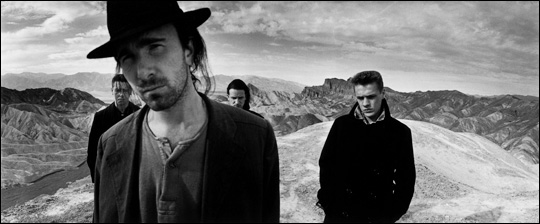
The American moodiness of Irishmen.
Thirty years ago this month and next, U2, Brian Eno, and Daniel Lanois were putting the finishing touches on what is arguably one of the greatest rock albums ever written, THE JOSHUA TREE. That “the album wears well,” even three decades later, would be a tragic understatement. Frankly, though I have listened to it repeatedly over the past 29 years, THE JOSHUA TREE sounds as fresh at the end of 2016 as it did in the spring of 1987. It’s possible that nostalgia—“the rust of memory,” as the great sociologist Robert Nisbet once proclaimed it—clouds my judgment, but I don’t think so. Other albums from that time that meant almost as much to me then sound dreadfully tinny and dated now.
So, my continuing and continuous awestruck response to THE JOSHUA TREE can’t be complete nostalgia.
The full article is at progarchy: https://progarchy.com/2016/12/16/on-the-edge-of-30-u2s-the-joshua-tree/
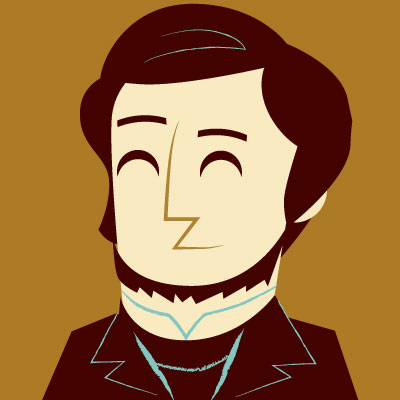
de Tocqueville, IHS version
Final Study Guide; Birzer the Fearsome
History of the Early American Republic (aka, “Jacksonian America”, H302)
Autumn 2016
I will provide the blue books for the exam. For each section, I am assuming your knowledge of the books assigned as well as of the lectures given. You will be graded on knowledge as well as wisdom!
Section 1. Possible essay questions.

Pope Paul III
Ok, getting toward the end of the semester.
For your pleasure (or pain), here is the third from last lecture, The Counter Reformation–a part of our drive-by Western Heritage tour!
We’re back to a *good* pope, Paul III. Phew, finally. It was getting a bit uncomfortable there for us Catholics for a while.
Back to sanity.
Response in the Western Latin (now what one would call “Roman Catholic”) Church:
Proto-Reformers: St. Francis, St. Dominic, Jan Hus (ca. 1372-1415), John Wyclif (ca. 1325-1384)
Lutheranism today: mostly Germanic and Scandinavian today (in those areas in the United States settled by Germans and Scandinavians). Essentially Catholic in form, if not in substance.
Many Baptists and fundamentalists today take Zwingli’s teachings on Communion (as memorial and only a memorial) and follow his practice of a plain church.
Anabaptists today:
Calvinist short hand
Calvinists today:
Off-shoots of Calvinism and Anabaptists: Baptists (certainly more democratic in church government)
Again, from Arnold Lunn, NOW I SEE (1945):
St. Mark is supposed to have written at St. Peter’s dictation. He tells the story of the denial without wasting a word. The chapter ends with a verse as simple as it is tragic. ‘And the second time the cock crowed.” And Peter called to mind the word that Jesus said until him, Before the cock crow twice thou shalt deny me thrice. And when he thought thereon, he wept.”
He wept. That is all, and that is enough.
It is possible that St. Peter’s defection was not unrelated to his sudden attack on the Chief Priests’s servant. He had cut off Malchus’s ear, and escaped into darkness. Only one person appeared to have guessed his identity, a servant of the High Priest and a kinsman of the luckless Malchus. He certainly had his suspicions. ‘Did not I see thee in the garden with him?” It was this question, according to St. John, which provoked Peter’s second denial. If this be so, it is easy to understand St. Peter’s failure of nerve. An homicidal attack on the servant of the Chief Priest was an offence which was probably punishable by death. St. Peter could hardly be expected to hand himself over to the officers of justice by confession. This much might be urged in St. Peter’s defence, but not by St. Peter.
The old Apostle dictates the story to St. Mark, and he neither defends nor reproaches himself. Why should he? Is it really necessary for him to insist that he should not have denied his master? Would anything be gained by a pen picture or a psychological analysis of his subsequent remorse?
The fisherman who had followed Christ was not concerned with the impression which his story might produce on the reader. He did not measure life by the verdict of men. He was therefore not tempted either to explain his defection or to impress upon the reader the sincerity of his remorse. He who had foreseen his weakness had also foreseen his strength. He who had foretold the denial had also foretold the cross outside the walls of Rome on which the chief of the Apostles was to reaffirm his faith.
“Jesus saith to Simon Peter, Verily, Verily, I say unto thee, When thou wast young, thou girdest thyself, and walkest whither thou wouldest: but when thou shalt be old, thou shalt stretch forth thy hands, and another shall gird thee, and carry thee whither thou wouldest not. This spake he, signifying by what death he should glorify God.”
From Arnold Lunn’s autobiography, NOW I SEE (1945):
Many forces have combined to produce the modern world. Palestine, Rome, Greece, and Communist Russia have all helped to form that strange complex which, in our more sanguine moods, we describe as civilisation. Of all the influences which have moulded European thought, the greatest is the Catholic Church. The Church saved from destruction the learning of the classical world. It was the Church which tamed and civilised the barbarians who swept down from the north. It was the Church which founded our seats of learning. It is to the Church we owe the inspiration which expressed itself in the greatest art and the noblest architecture which the world has ever seen. There is no aspect of our modern life, law, education, art or architecture which has not passed at some period through the mould of the Catholic Church. (pg. 125)
 Stormfields