Russell Kirk, “Humane Letters and Modern Fragmentation,” 1960
SOURCE: Russell Kirk, “Humane Letters and Modern Fragmentation,” CATHOLIC MIND 60 (November 1962): 4-10.
SOURCE: Russell Kirk, “Roots of Our Civilization,” PHALANX 1 (Spring 1967): 9-14.
SOURCE: Russell Kirk, “Rebellion Against Boredom,” in Frederick Wilhelmsen, ed., SEEDS OF ANARCHY: A STUDY OF CAMPUS REVOLUTION (Dallas, TX: Argus Academic Press, 1969), 26-37.
SOURCE: Russell Kirk, “The Best Form of Government,” CATHOLIC WORLD 192 (December 1960): 156-163.
As Winter gives way to another Spring, new album releases are finding their way onto my radar in ever increasing numbers. Three new CDs dropped onto my doormat in rapid succession a couple of days ago and each, in its own way, is making a big first impression.

First up, we have Please Come Home, by Lonely Robot, John Mitchell’s new solo project. This is a disc that grabs you immediately – melodic and catchy as hell, with superb guitar playing throughout. If you enjoyed Sound Of Contact’s debut, or the recent release from former SoC member Dave Kerzner, there’s a strong possibility that you will fall in love with this. A proper review will follow soon…
Next is Public Service Broadcasting‘s second full album release, The Race For Space. If you’ve not heard this band, you really should give them a listen. They expertly blend sampled clips from…
View original post 201 more words
Review: The Neal Morse Band, ALIVE AGAIN TOUR, Aurora, Colorado, February 28, 2015.
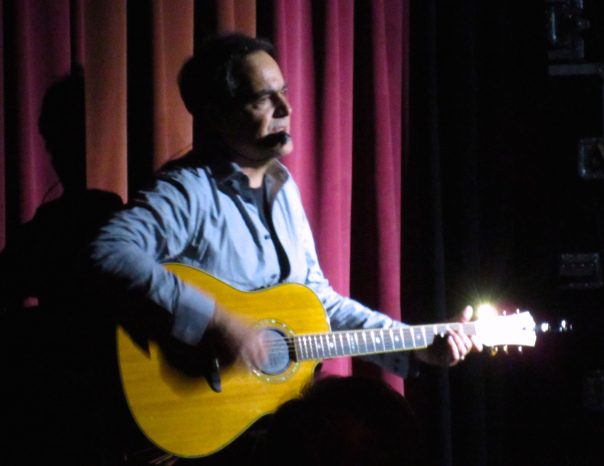
Neal, in a quiet acoustic moment, singing “Somber Days” from TESTIMONY.
Last night, I had the incredible privilege of seeing the Neal Morse Band live in Denver (actually, in the suburb of Aurora), playing at the Soiled Dove Underground. To make it all so much better, I had the company of my beautiful, prog-friendly wife, Dedra. Colorado prog friends, Geddy, Vince, and Amy, were there as well. And, just to make the company even more interesting, Dedra and I sat with two brothers—Joe and Dave, originally from Columbus, Ohio, but now residing in Denver. Joe might even have been a bigger Neal Morse fan than I am, if such a thing is possible. The guy waved, pumped his fist, and screamed “amen” throughout the whole show. I loved it. Before and after the concert, we talked about…
View original post 894 more words
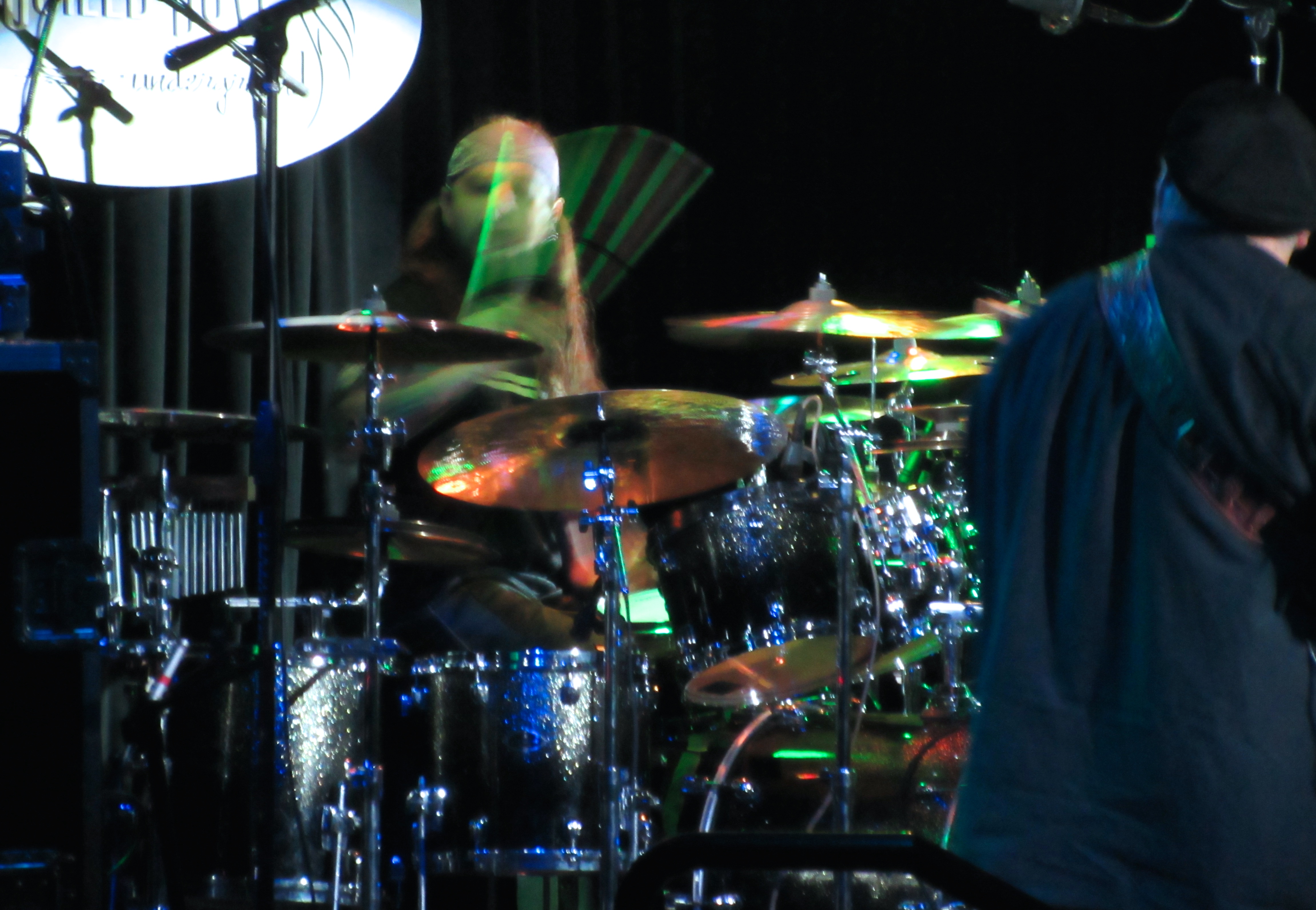
As the 1970s turned into the 1980s, hard rock and progressive bands were taking serious stock, re-inventing sounds that had sustained them and, for fans, defined an era. The list of bands who turned the corner of the 1980s influenced by punk and disco and new wave is long, and includes many touchstone bands of prog and heavy rock: Yes, Genesis, Led Zeppelin, ZZ Top, The Rolling Stones, Judas Priest. Songs became shorter, tighter, glossed in reverb and electronics. In an odd way the 1960s really ended around 1979-80. It was a death toll for bands unable to adapt to the FM version of the pop single.
Maybe it’s nostalgia, maybe it’s hindsight, but looking back at those handful of years I find it fascinating that three of rock’s great survivors — AC/DC, Black Sabbath, Rush — issued essential work in this time of transition. You won’t find three bands…
View original post 1,204 more words
Leah, KINGS AND QUEENS (Innerwound Recordings, 2015).
Track listing: Arcadia; Save the World; Angel Fell; Enter the Highlands; In the Palm of Your Hand; Alpha et Omega; Heart of Poison; Hourglass; Palace of Dreams; This Present Darkness; The Crown; Remnant; There is No Farewell; Siuil a Run
Birzer rating: 9.55/10
***
Leah McHenry is a diamond, but not in the rough. Indeed, her talents are perfectly shaped and polished, ready to appear alone or in a company of other gems. Whatever the setting, though, Leah will be the brightest in the room.
I’m not sure I could honestly call this piece a review in any journalistic or Brian Watson-sense of the term “review.” I count Leah among my friends, however much distances across North America might separate us, and I’m proud to include anything she does as progarchist. At a personal level, she and I share the same views on political…
View original post 843 more words
“In truth, nature beings to relate to us only when we begin to indwell in it, when culture begins in it. Culture then develops and, bit by bit, nature is refashioned. We create our own world, shaped by thoughts and controlled not merely by natural urges but by ends that we set to serve ourselves as intellectual and spiritual beings, an environment that is related to us and brought into being by us.” (10)
“All intellectual and spiritual activity presupposes a kind of asceticism, of break up of nature, of dissolving and dematerializing it. Only then can we do our human work.” (11)
“In this new sphere things are no longer directly detected, seen, grasped, formed, or enjoyed; rather, they are mediated by signs and substitutes.” (20)
“The one sinks into a things and its context. The aim is to penetrate, to move within, to live with. The other unpacks, tears apart, arranges in compartments, takes over and rules.” (43)
“The other form of knowledge and its mastery is very different. It began to emerge already during the Renaissance but has really come into its own very recently. This knowledge does not inspect, it analyzes. It does not construct a picture of the world, but a formula. Its desire is to achieve power so as to bring force to bear on things, a law that can be formulated rationally. Here we have the basis and character of its dominion: compulsion, arbitrary compulsion devoid of all respect.” (44)
“We see the same phenomenon in politics. Here statistics provides the basis. A host of bureaucrats makes use of statistics and governs by this means. Newspapers, put in the service of goal-directed slogans, mold public opinion; so do posters and films. Similarly, the monstrous organization of economic life works rationally and arbitrarily like a machine. It both serves politics and controls it. It has a profound impact on cultural life by means of the radio, the control of the press, theater, music, and travel.” (47)
“a technique of controlling living people is developing.” (47)
“At all events, the anxious question arises: What will become of life if it is delivered up to the power of this dominion? Living events go their own ways, ways of development, sensitive, deep-rooted ways. They have their own profound sureness. They are infinitely tender but also inconceivably strong and invincibly powerful so long as they remain in their own essential courses. But these courses are now heading for the dark. The creativity is now unconscious. Things seem to be following no rule, to be taking place simply at will. What will happen when these events become subject to the harsh consciousness of rational formulas, the power of technical compulsion? A system of machines is engulfing life. It defends itself. It seeks free air and a secure basis. Can life retain its living character in this system?” (49)
“Rankings formed. Individual vocations had their own value and dignity, but did not prevent recognition of higher and lower vocations. Similarly, final equality before God did not prevent the formation of classes on a scale and intellectual ranking. Life was strongly grasped, and vocational work was done. But that did not involve any confusion on the everyday with the sublime, of the profane and the sacred.” (55)
“Tradition was in time what air and water and soil are in space. We thus have two things. On the one hand, a developed humanity has slowly achieved clearly evolved forms and has developed powers of seeing, owning, living, thinking, ruling, and creating. On the other hand, we have appropriately formed work, mature and full creation-not a numerical but an intensive fullness. Life pulses through it down to the last member. The multiplicity of life finds expression in a thousand details. Every gate, lattice, and staircase, every proverb, custom, office, and tradition has been vitally formed and produced. So flexible is the creative work! It divides into different types, classes, human ranks, and seasons of the year. And all of it, material, work, content, is authentic. But the masses have changed all this.” (57)
“Unlimited production means that every art of force and cunning must be used to produce unlimited consumption!” (59)
“Everywhere we find hybridization. All rankings are lost. We all think we are justified in whatever we do. We are no longer tied to the essence of content or the historical or social dignity of form.” (59)
“How vulgar life has become in every sphere, even in religion.” (59)
“But here everything is made showy and trashy-and the more hopelessly so, the greater the technical perfection. So it is with everything. . . . They bring them all into the trashy sphere, that is, within reach of the masses.” (61)
“Take religious drama, the ordinary mysteries. Just a few more of them, a few more years of legends and religious lyrics, and our life of faith will no longer be healthy. What is the Christmas event when it is reduced to sweet nothings in a hundred nativity plays?” (61)
“People did, of course, use tools and aids in great numbers and with great delicacy. But these were only supports, extending the range of activity of natural human organs, making possible more acute and accurate seeing and hearing, working, understanding, and controlling. The means were always integrated into the interplay of the human unit, and a limit was always set to make possible direct and living execution.” (66)
“Individual forces such as steam, electricity, and chemical energy have been taken out of their natural context. We know their rational laws, and on the basis of this knowledge we can unleash their power.” (71)
“Our age is different from what has come before it. It is not different merely as the Renaissance is compared to the Middle Ages. The difference goes incomparably deeper. It often seems to me that the period from 1830 to 1870 is the watershed. All things before that, however different, belong together. They rest on a similar basic attitude, share the same human standard, are integrated into nature and its proportions. What has come since seems to be governed by a different basic attitude, by the desire to set goals independently of organic connections and on the basis of rationally emerging forces that are mechanically put in the service of this desire and its goals.” (75)
“It is destructive because it is not under human control. It is a surging ahead of unleashed forces that have not yet been mastered, raw material that has not yet been put together, given a living and spiritual form, and related to humanity.” (79)
“Our age is not just an external path that we treat; it is ourselves. Our age is our own blood, our own soul.” (81)
“God is at work. History is going forward in the depths, and we must be ready to play our part, trusting in what God is doing and in the forces that he has made to stir within us.” (96)
Source: Romano Guardini, LETTERS FROM LAKE COMO (Grand Rapids, MI: Eerdman’s, 1994).
“I trust, however, that you will allow me to regard it also as the impersonal welcome offered by citizens of the great republic of letters to another citizens whose only credentials and recommendations are those with which his citizenship provides him.” (1)
“Our business here, I take it, is to consult about matters which seriously affect the welfare of our republic, and I may assume therefore that we are prepared to approach it in no provincial or parochial spirit, but in a truly republican frame of mind, intent only upon the interest to which our first allegiance is due, the interest of the republic of letters.” (1-2)
“If Socrates had come before the Athenians with some fine new piece of machinery like a protective tariff, workmen’s compensation, old age pensions, collective ownership of the means of production, or whatnot; if he had told them that what they must do to be saved was simply to install his piece of machinery forth with, and set it going; no doubt he would have interested a number of people, perhaps enough to put him in office as the standard-bearer of enlightened and progressive liberalism. When he came before them, however, with nothing to say but Know thyself, they found his discourse unsatisfactory, and became inpatient with him.” (Pages 2–3)
“Yes you may not be at all an educated person, but only an instructed person.” (Page 7)
“The word sends us back to a phrase of Plato. The person of intelligence is the one who always tends to ‘see things as they are,’ the one who never permits his view of them to be directed by convention, by the hope of advantage, or by an irrational and arbitrary authoritarianism. He allows the current of his consciousness to flow in perfect freedom over any object that may be presented to it, uncontrolled by prejudice, prepossession or formula; and thus we may say that there are certain integrities at the root of intelligence which give it somewhat the aspect of a moral as well as an intellectual attribute.” (Pages 8–9)
“Too much attention has been paid to the languages, literature and history of classical antiquity, which were all a far less than helpful value to the youth of 20th century America. The thing now was to introduce the sciences, living languages and the useful arts, to make instruction vocational, to open all manner of opportunities for vocational study, and to introduce youth into her institutions for pretty strictly vocational purposes. All this was done; the process amounted to a revolution, carried out with extraordinary thoroughness and in an astonishingly short time. Hardly any debris of the order remains except, curiously, the insignia of certain proficiencies; these now survive as mere vestiges. You will as well aware as I, for example, of what a bachelor’s degree in liberal arts now represents. Some new insignia have been devised, and one or two borrowed from the systems of other countries, like the degree of doctor of philosophy, which fulfills the humble but possibly necessary function of a factory–inspection label, some say a trade–union label; perhaps it is both. Aside from these insignia, however, nothing is left; our system underwent a revolutionary renovation. Exponents of the new order have had their way unhindered, and have been able to command it almost inconceivable amount of money and enthusiasm in support of their plans and policies. Yet after three decades of this, our system gives no better satisfaction, apparently, than it did before. At no time during this period has it given satisfaction; hence the period has been one of incessant tinkering, the likes of which probably has never been seen anywhere in the world. Method after method, device after device, readjustment after readjustment, have been tried, scrapped, revised and modified, and then tried again. One might say that the field of our pedagogy during these last three decades has been the drill ground of empiricism; large areas of that, indeed, seem to have been, and still seem to be, the hunting–ground of quackery. One cannot too much wonder at the high hopefulness attending this unconscionable revel of experimentation. Yes, yes, we kept saying, let us but just installed this one new method in the secondary schools, with this one new set of curricular changes in the undergraduate college, with this one brand-new scheme for broadening the scope of university instruction, and in a year or so it will prove itself to be the very thing we have all along been needing; and this, that or the other batch of pedagogical problems will be laid to eternal rest. Such, I think, is a fair summary of our thirty years’ experience.” (Pages 12–13)
“At the 55th anniversary of the founding of Johns Hopkins University, Mr. Lang said that the type of education offered in our new million-dollar high schools is about 1/20 as valuable as the kind given in the traditional little red schoolhouse of a generation ago.” (19)
“I have mentioned the fact that our system has been subjected to incessant tinkering throughout the post revolutionary period. We may now observe that all this tinkering has been purely mechanical and external; it is been applied exclusively to the structure and mechanics of the system.… I do not recall the names of more than one or two of them, they are so many have come and gone in such quick succession.” (21)
“Its interpretation frequently betrays a fast ignorance of what the humane life really is, and of the discipline whereby alone one may make progress towards this life.” (26)
“The first idea was that the quality; the second, that of democracy; and the third idea was that the one great assurance of good public order and honest government lay in a literate citizenry.” (27)
“Our system is based upon the assumption, popularly regarded as a illicit in the doctrine of equality, that everybody is a educable.” (30-31)
“You know its chosen machinery was that of a republic, as affording the best power or purchase for the free expression of this right. As a matter of logic, when everybody votes, you have a democracy; the registration of democratic judgment is a mere matter of counting ballots. Thus the confusion of terms set it; a republic in which everybody voted was accepted as a democracy and was so styled, as it still is. This confusion persists, and the evidence of it is on every other page of many, I think the great majority, serious writers. In fact, we may say that the terms republican and democratic have come to be regarded as synonymous.… Republicanism does not, therefore, of itself even imply democracy.” (34–35)
“Meanwhile, on the top of this, which we may call an academic error, grew the popular error which accepted as democratic a whatever was merely indiscriminate.” (37)
“There is no such thing as democratic manners; manners are either bad or good.” (38)
“The popular idea of democracy is animated by a very strong resentment of superiority. It resents the thought of an elite.” (38)
“The whole institutional life organized under the popular idea of democracy, then, must reflect this resentment. It must aim at no ideals above those of the average man; that is to say, it must regulate itself by the lowest common denominator of intelligence, taste and character in the society which it represents.” (39)
“Any expectations put upon the saving grace of literacy are illusory.” (44)
“After the three R’s, or rather for a time in company with them, his staples were Latin, Greek and mathematics.” (50)
“The literatures of Greece and Rome comprise the longest and fullest continuous record available to us, of what the human mind has been busy about in practically every department of spiritual and social activity; every department, I think, except one—music. This record covers 2,500 consecutive years of the human mind’s operations in poetry, drama, law, agriculture, philosophy, architecture, natural history, philology, rhetoric, astronomy, politics, medicine, theology, geography, everything. Hence the mind that has attentively canvassed this record is not only a disciplined mind but an experienced mind; a mind that instinctively views any contemporary phenomenon from the vantage-point of an immensely long perspective attained through this profound and weighty experience of the human spirit’s operations. If I may paraphrase the words of Emerson, this discipline brings us into the feeling of immense longevity, and maintains us in it. You may perceive at once, I think, how different would be the view of contemporary men and things, how different the appraisal of them, the scale of values employed in their measurement, on the part of one who has undergone this discipline and on the part of one who has not. These studies, then, in a word, were regarded as formative because they are maturing, because they powerfully inculcate the views of life and the demands on life that are appropriate to maturity and that are indeed the specific marks, the outward and visible signs, of the inward and spiritual grace of maturity. And now we are in a position to observe that the establishment of these views and the direction of these demands is what is traditionally meant, and what we citizens of the republic of letters now mean, by the word education; and the constant aim at inculcation of these views and demands is what we know under the name of the Great Tradition of our republic.” (52–53)
“The aim at an inculcation of these views and demands is the Great Tradition of a truly civilized society.” (54)
“The reason it did not work was that this process postulated an educable person, and everybody is not educable. From it, we discovered that relatively very few are educable, very few indeed. There became evident an irreconcilable disagreement between our equalitarian theory and the fact of experience. Our theory assumes that all persons are educable; our practical application of it simply showed that the Creator, in His wisdom and in His lovingkindness, had for some unsearchable reason not quite seen His way to fall in with our theory, for He had not made all persons educable.” (55)
“anybody can be trained. Practically any kind of mentality is capable of making some kind of response to some kind of training; and here was the salvation o four system’s theory. If all hands would simply agree to call training education, to regard a trained person as an educated person and a training school as an educational institution, we need not trouble ourselves about our theory; it was safe. Since everybody is trainable, the equalitarian side of our theory was safe.” (59)
“What we did, then, actually, was to make just this identification of training with education, and to reconstruct our system accordingly; and this was the revolution of thirty-five years ago.” (60)
“Science touched the popular sense of awe and wonder. In a memorable conflict with many of the dogmatic constructions of organized Christianity, it did come off easily first best; and this had immense popular significance, such significance as is hard for us now even to imagine. Men’s minds were for the marvels of science; their imaginations were busy with its alluring prospect of further marvels.” (63)
“They do so because they rests wholly upon evidence of the senses. I do not say that all science rests upon evidence of the senses—there is no need to raise that point—but only that these dilutions do, and that therefore they are accessible to an extremely low order of intelligence, and are easily taught.” (64–65)
“Interest in vocationalism also affected the content of our new procedure. The teaching of science answered the innovators demand that our system should be modern and up-to-date, that we should be “men of our time.”” (66)
“Let us speak of the University and the undergraduate college. Traditionally, the University was an Association of scholars, grouped in four faculties; literature, law, theology and medicine. When I say an Association of scholars, I mean that it was not quite precisely what we understand by a teaching institution. The interest of the students was not the first interest of the institution. Putting it roughly, the scholars were busy about their own affairs, but because the Great Tradition had to be carried on from generation to generation, they allowed certain youngsters to hang about and pick up what they could; they lectured every now and then, and otherwise gave the students a lift when and as they thought fit. The point is that the whole burden of education lay on the student, not on the institution or on the individual scholar. Traditionally, also, the undergraduate college but the whole burden of education on the student. The curriculum was fixed, he might take it or leave it; but if he wished to proceed bachelor of arts, he had to completed satisfactorily. Moreover, he had to complete it pretty well on his own; there was no pressure of any kind upon an instructor to get him through it.” (73)
“I have no need to remind you that the responsibility for continuous exercise of an absolutely spotless intellectual integrity rests most heavily upon those who pretend to be the continuators of the Great Tradition. It is of the essence of the Great Tradition that the disinterestedness and objectivity imply in Plato’s phrase should, first and last and most inflexibly, be maintained upon ourselves, our interests and desires, above all upon our ambitions and achievements.” (80)
“It is fair, I think, to say that our institutions have conducted among themselves a grand competition for numbers, on rudeness terms; first, by shifting the burden of education from the student to the instructor, and putting pressure on the instructor to let his students go through as lightly and quickly as possible; and second, by offering a choice among an immense number of subjects that are easily taught, and easily accessible to a very low order of mind.” (81–82)
“Why should this be so? Forty years ago, our English-speaking students learned English quite informally; it was our own tongue, we were bred to a native idiomatic use of it, such a use ss none but a native can ever possibly acquire. To say that English was not taught in our higher institutions means merely that everybody taught it. No matter what the stated subject under discussion might be, if we expressed ourselves inaccurately, loosely, on unidiomatically, we heard about it at once and on the spot, and in terms that forcibly suggested a greater carefulness in the future.” (85)
“In the Middle Ages, the association of educable persons with them, and the exposure to the spiritual influences that they generated, pretty well made up all there was to education.” (93-94)
“Another interesting feature of this present condition of affairs is the only disappearance of what may be called the non-–professional scholar.” (98)
“One of the most interesting and significant assumptions in the world is that which you will nowadays encounter everywhere in American society: if a person shows signs of having an education, properly so-called, the assumption is almost invariably, first, that he got it in Europe, and second, that he makes his living by it or at least uses it for purposes of profit.” (99–100)
“The other suggestion I would make is that having thus dropped all pretense to an educational character, our system and its institutions should drop all titles, like that of college and university, which by age long usage intimate this character. Our system is not educational; we have seen that its fundamental theory makes it possible to attribute any such character to it. Its institutions are not educational institutions. Why, then, should there be any pretense to the contrary?” (116)
“Yet I repeat that there is great violence and great propriety in describing it as a university organization; great violence, in resting a very old title quite away from anything remotely resembling its traditional significance; and great impropriety, by consequence, in exposing the public, always careless in such matters, to the risk of most serious misapprehension.” (117)
“Surely there is nothing discreditable, say, about the name Institute; is in good usage everywhere, and carries just the right notion of what now goes on under the name of University work. As far as I know, there does not exist a University or undergraduate college, in the traditional and proper sense, anywhere in the country. I cannot see that there would be any conceivable sacrifice of prestige if our institutions honorably and scrupulously gave up a title to which they have but a most questionable right, and called themselves institutes.” (118–119)
“Well, I do not press either suggestion, even though I think that the matter of nomenclature is important because words have power.… A just care for words, a reasonable precision in nomenclature, is of great help in maintaining one’s intellectual integrity.” (121)
“The educable person, in contrast to the ineducable, and is one who gets promise of someday being able to think; and the object of educating him, of subjecting him to the Great Traditions discipline, is to put him in the way of right thinking, clear thinking, mature and profound thinking. Now, the experienced mind is aware that all the progress of actual civilization that society is ever made has been brought about, not by machinery, not by political programs, platforms, parties, not even by revolutions, but by right thinking.” (124)
“Nature takes her own time, sometimes a long time, about exacting her penalty and often gets added by strange, unexpected and roundabout way; but exact it in the end she always does, and to the last penny.” (125)
“Our society can get along for considerable periods by the process known as “muddling through,” in more or less cheerful disregard of the absence of thought and intelligence we take up the tabernacle of Moloch and Chiun, our images—Mr. Coolidge’s two-gallon hat and Mr. Henry Ford’s conveyor-system—and follow the star of our god Buncombe along ways which seem not too insecure.” (132)
“Even so may we say that it is a great art to know how to be on living terms with the Great Tradition. We call ourselves continuing to of the Great Tradition are aware with bitterness that in so styling ourselves we are but voicing an aspiration, we are but offering our reference to a distant, high and unapproachable ideal. We know better than anyone can tell us, how slight is our proficiency in the great art of familiar converse with it. Well, then, in a society that not only has lost that art that has lost even the knowledge that such an art exists, a society in which the Great Tradition itself is in complete abeyance—but I think I need say no more, the conclusion is manifest, it is inescapable.” (153–154)
“I may remind you—though I should not say that; let me rather say I may put into words what I know is in the consciousness of us all—that the Great Tradition will be no man’s debtor. When we speak of promoting it or continuing it, we are using a purely conventional mode of speech, as would we say that the sun rises or sets. We can do nothing for the Great Tradition; our fidelity to it can do everything for us. Creatures of the day, how shall we think that what we do or leave undone is of consequence to that which abides forever? Our devotion, our integrity of purpose, our strictness of conscience, are not exercised in behalf of the Great Tradition, but in our own behalf. Our recreancy cannot weaken it, our faithfulness cannot strengthen it; we alone are damaged by the one and edified by the other. The Great Tradition is independent of us not we of it. We cannot augment or diminish the force of its august and salutary laws; we can but keep to them, and therein find our exceeding great reward. We have therefore no responsibility but the happy one of keeping our eyes single to our own obedience. We need take no thought for the Great Traditions welfare, but only for our own; it asks no protection or championship from us, and any volunteer service of this kind is mere officiousness.” (155-156)
“We are called to be disciples, not energumens. The Great Tradition will go on because the forces of nature are on its side; it has on its side and invincible ally, the self preserving instinct of humanity. Men may forsake it, but they will come back to it because they must; their collective existence cannot permanently go on without it. Whole societies may disallow it and set it at naught, as ours has done; they may try to live by ways of their own, by bread alone, by bread and buncombe, by riches and power, by economic exploitation, by intensive industrialism, quantity–production, by what you please; but in the end they will find, as so many societies have already found, that they must return and seek the regenerative power of the Great Tradition, or lapse into decay and death.” (157).
“I do not think that our American society will ever return to the Great Tradition. I see no reason why it should not go on repeating the experience of other societies, having already gone as far as it has along the road of that experience, and find that when it at last realizes the need of transforming itself, it has no longer the power to do so. The terrible words of Perseus are as applicable to the tyranny of ideas as to any other mode of grasping and ruthless dictatorship. But this is no concern of ours. The Great Tradition has not left itself without abundant witness in contemporary societies, and as I began by saying, the constitution of the republic of letters knows no such thing as political nationalism. Our fellow citizens are ours where we find them; and where they are not to be found we may regard ourselves as citizens in partibus, uncommitted to an officious and ineffectual evangelism. Our allegiance is to the Constitution of our republic; we are committed only two clear understanding and right-thinking. If our present discussion has been of any avail in encouraging these, we may perhaps believe that the intention of this Lectureship has been in some degree fulfilled.” (159–160)
Source: Albert Jay Nock, THE THEORY OF EDUCATION IN THE UNITED STATES (New York: Harcourt Brace, 1932).
“Ever since the Civil War, political thought has languished in the United States. For original political theory almost always is developed out of a time of troubles, when thinking men, forced to examine their first principles, seek means to avert the imminent collapse of order, or to restore some measure of justice and security to a wounded society. The political writings of Plato and Aristotle came out of such an age. So did Cicero’s works, and Dante’s, and Machiavelli’s, and Hooker’s, and Hobbes’s, and Locke’s, and Burke’s, and Marx’s. The nature of the confusion which provokes the exposition of political theory may be the inadequacy of an old order, morally and administratively.” (142)
“No political philosopher of any great stature appeared during the last third of the nineteenth century, and the bulk of what passed for political thought in this country was simply the reflection of various English and German liberal ideas, adapted to the American climate of opinion. There seemed to be no need for reference to first principles; Things were in the saddle, and most men seemed to be satisfied to let Things ride” (142).
“Yet Things galloped on; the New Deal, fortunately perhaps, was the expression of vague humanitarian aspirations and positive grievances, not of any coherent ‘liberal’ or ‘radical’ system of thought. Nor was America’s part in World War II governed by any body of general ideas: caused by the combination of moral indignation with fear of Germany and Japan, American intervention stood bewildered for want of theory when the problems of peace had to be met.” (143)
“Yet there may come a time in the history of nations when the previous security against foreign intervention is destroyed, and when the tradition established usage are so weakened that they cannot stand unaided against the assaults of ideology. Such an era seems to be America’s in the middle of the twentieth century.” (143)
“Conservatism in the United States, by the end of the 1940’s, had almost lost the power of language. Very often, men of conservative prejudices expressed themselves apologetically in the phrases of nineteenth-century liberals; sometimes they even echoed the slogans old-fangled anarchism.” (144)
“Any healthy society requires an enduring contest between its permanent and its progression. We cannot live without continuity, and we cannot live without prudent change.” (145)
“For politics, like science, like art, comes out of belief in a transcendent religion; and when the first belief decays, politics decays, and the fancied terrestrial paradise becomes a very real terrestrial hell.” (146)
“It would be presumptuous to endeavor to summarize the whole of Mr. Voegelin’s work before his six fat volumes have appeared. My present purpose is to suggest that such principles as Mr. Voegelin expounds are the principles which increasingly are being recognized by thinking American conservatives as the foundation of their beliefs. The names of Bernard Iddings Bell, R.S. Nisbet, Leo Strauss, Ross Hoffman, and Reinhold Niebuhr may suggest the range of conservative views founded upon belief in a transcendent order, in an unalterable human nature, and in a natural law.” (148)
“Conservatism begins with the premise that we must be obedient to a transcendent order which has given us natural law. The nature of man being complex, no simple set of positive laws, universally applied, will suffice to make him happy or good. And the nature of man being flawed, the evil part of his nature, lusting after power and aggrandizement, envious and violent, must be restrained by custom, authority, and balanced government which checks power with power.” (148)
“Populism and the New Deal merely aped the spurious utopia of business enterprise, without having any concept of a fundamental change in the quality of American life; the New Dealers, indeed, were glad to escape into the war and so avoid any re-examination of their own principles.” (149)
Source: Russell Kirk, “Return to Principle in Politics: Conservatives and Liberals Take Thought,” Southwest Review 41 (Spring 1956): 142-152.