
Stormfields

Aldous Huxley, “Time and the Machine”

[Transcription for the chapter, “TIME AND THE MACHINE,” The Olive Tree and Other Essays (London: ENG: Chatto and Windus, 1936), pp. 122-124]

la-et-jc-aldous-huxley-20160726-snap

Aldous Huxley from the L.A. Times.

Time, as we know it, is a very recent invention. The modern time-sense is hardly older than the United States. It is a by-product of industrialism–a sort of psychological analogue of synthetic perfumes and aniline dyes.

Time is our tyrant. We are chronically aware of the moving minute hand, even of the moving second hand. We have to be. There are trains to be caught, clocks to be punched, tasks to be done in specified periods, records to be broken by fractions of a second, machines that set the pace and have to be kept up with. Our consciousness of the smallest units of time is now acute. To us, for example, the moment 8:17 A.M. means something—something very important, if it happens to be the starting time of our daily train. To our ancestors, such an odd eccentric instant was without significance–did not even exist. In inventing the locomotive, Watt and Stevenson were part inventors of time.

Another time-emphasizing entity is the factory and its dependent, the office. Factories exist for the purpose of getting certain quantities of goods made in a certain time. The old artisan worked as it suited him with the result that consumers generally had to wait for the goods they had ordered from him. The factory is a device for making workmen hurry. The machine revolves so often each minute; so many movements have to be made, so many pieces produced each hour. Result: the factory worker (and the same is true, mutatis mutandis, of the office worker) is compelled to know time in its smallest fractions. In the hand-work age there was no such compulsion to be aware of minutes and seconds.

Our awareness of time has reached such a pitch of intensity that we suffer acutely whenever our travels take us into some corner of the world where people are not interested in minutes and seconds. The unpunctuality of the Orient, for example, is appalling to those who come freshly from a land of fixed meal-times and regular train services. For a modern American or Englishman, waiting is a psychological torture. An Indian accepts the blank hours with resignation, even with satisfaction. He has not lost the fine art of doing nothing. Our notion of time as a collection of minutes, each of which must be filled with some business or amusement, is wholly alien to the Oriental, just as it was wholly alien to the Greek. For the man who lives in a pre-industrial world, time moves at a slow and easy pace; he does not care about each minute, for the good reason that he has not been made conscious of the existence of minutes.

This brings us to a seeming paradox. Acutely aware of the smallest constituent particles of time–of time, as measured by clock-work and train arrivals and the revolutions of machines–industrialized man has to a great extent lost the old awareness of time in its larger divisions. The time of which we have knowledge is artificial, machine-made time. Of natural, cosmic time, as it is measured out by sun and moon, we are for the most part almost wholly unconscious. Pre-industrial people know time in its daily, monthly and seasonal rhythms. They are aware of sunrise, noon and sunset, of the full moon and the new; of equinox and solstice; of spring and summer, autumn and winter. All the old religions, including Catholic Christianity, have insisted on this daily and seasonal rhythm. Pre-industrial man was never allowed to forget the majestic movement of cosmic time.

Industrialism and urbanism have changed all this. One can live and work in a town without being aware of the daily march of the sun across the sky; without ever seeing the moon and stars. Broadway and Piccadilly are our Milky Way; out constellations are outlined in neon tubes. Even changes of season affect the townsman very little. He is the inhabitant of an artificial universe that is, to a great extent, walled off from the world of nature. Outside the walls, time is cosmic and moves with the motion of sun and stars. Within, it is an affair of revolving wheels and is measured in seconds and minutes–at its longest, in eight-hour days and six-day weeks. We have a new consciousness; but it has been purchased at the expense of the old consciousness.
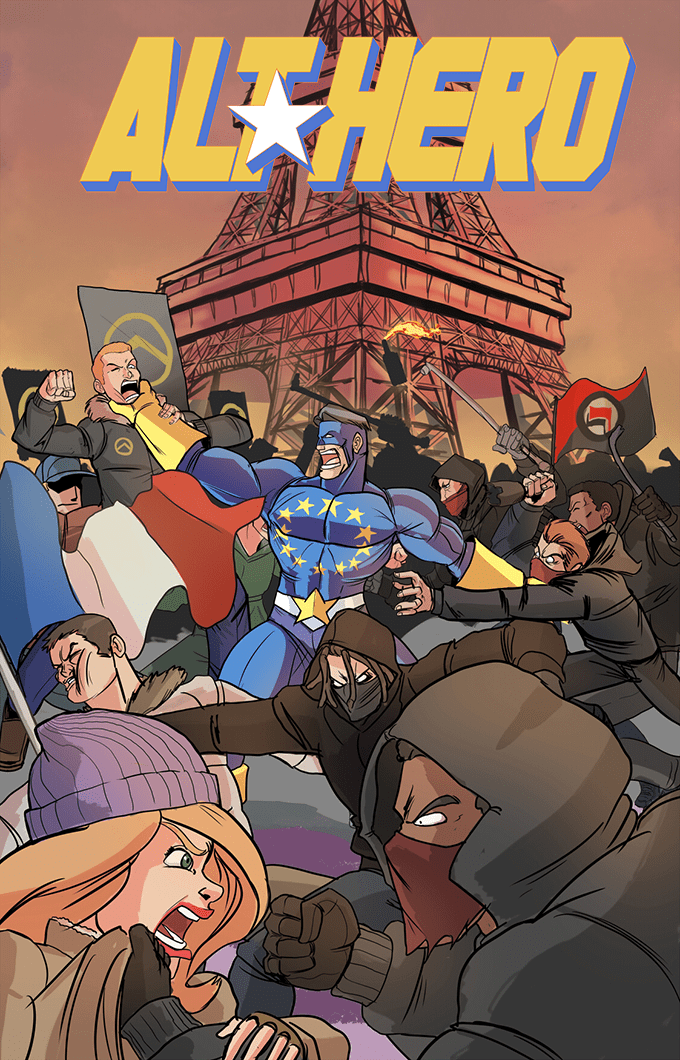
Support Chuck Dixon’s New Universe

AH_002Only two more days to support Chuck Dixon and his new universe.  Please do!

Alt★Hero is a world not too terribly different than our own. It is a world where the Wehrmacht generals overthrew Adolf Hitler and the Nazi Party in 1939, and where the first atomic bomb was dropped on the order of Reichskanzler Jodl on Soviet territory in 1944, leading to the fall of the Soviet Union in 1956. It is a world where Japan attacked Australia instead of Pearl Harbor and China occupies the Korean Peninsula. It is a world of four superpowers, where the European Union rivals the United States of America for wealth and influence, and where China and Russia possess the two most formidable militaries on the planet.

https://freestartr.com/project/althero/

The God of the Hebrews: Genesis 1-3

What matters most profoundly to the student of history is the revelations about God (sovereign), the created order (good), and humanity (fallen). If a person knows nothing but the first three chapters of Genesis, he will have, at least, a semblance of understanding of the human condition… While the ancient Hebrews were not the first…

via God of the Hebrews — The Imaginative Conservative

Elizabeth Hamilton’s Interviews

Over the last few months, I’ve had a blast interviewing and writing about a number of authors who’ve visited Dallas. For fellow bibliophiles, if you missed these stories on social media, here are links to my most recent books-related pieces. * I had the pleasure of interviewing children’s book author Carol Weston about her most […]

via ICYMI: author interviews — elizabeth hamilton

Canonicity of the New Testament

lindesfarne

A page from the Lindesfarne Bible.

Canonicity of the New Testament.  The English word “Gospel” was first coined in 950AD in Lindesfarne, by an Anglo-Saxon monk/priest.  It means “God’s spell” or “God’s story.”  It is a translation of the Greek word euangelion.


Dates of the various books of the New Testament:

Date                                                                  Writing                                           Author

  • 51-52                                                               1 and 2 Thess.                                 Paul
  • 50-55     Gospel Matthew
  • 50-60                                                               James                                              James
  • 54                                                                    Galatians                                         Paul
  • Spring 57                                                          1 Corin                                           Paul
  • 57-58                                                               2 Corin                                           Paul
  • 57-58                                                               Romans                                          Paul
  • 60                                                                    Gospel                                            Mark
  • 62                                                                    Philippians                                     Paul
  • 62                                                                    Col., Philem., Eph                             Paul
  • 62                                                                    Gospel                                            Luke
  • 64                                                                    1 and 2 Peter                                  Peter
  • 65                                                                    1 Tim and Titus                              Paul
  • 65                                                                    Hebrews                                         Unknown
  • 66                                                                    2 Timothy                                      Paul
  • 70                                                                    Jude                                                Jude
  • 85-95                                                               Rev.                                                John
  • 95-100                                                             1,2,3, John                                       John
  • 98-100                                                             Gospel                                            John 


A few considerations:

  • A New Testament writing was only considered canonical by the early church if it was written by an apostle—one who knew Jesus directly and personally before the crucifixion. Paul and St. Luke are the obvious exceptions to this.  As Cyril C. Richardson of Union Theological Seminary has written: prior to 150AD, “Christian preaching was founded on the Old Testament and on the living tradition of Jesus, passed from mouth to mouth.  This feeling for personal witness was very strong in the Early Church.”
  • Each of the New Testament writings was originally written in Greek, except for St. Matthew’s Gospel, which was most likely written in Aramaic.
  • The reading of the New Testament (or some semblance of it) became a standard, orthodox part of the mass/service only around 150AD. Prior to that date, most services only looked to the Septuagint (Greek Old Testament) as orthodox.  A large part of accepting the New Testament came as a reaction to the developing heresies.  The most dangerous in the second century of Christianity was Marcionism, which accepted only “The Gospel and the Apostle,” meaning a part of the Gospel of Luke and parts of ten of Paul’s letters, with any reference to the Old Testament edited out.
  • There were numerous copies and variations of each letter/Gospel floating around the Christian world in the first several centuries of the Church.
  • There were considerable disputes between the western and the eastern churches over: Hebrews, because the author is unknown; and The Apocalypse/Revelation of St. John, because it was often considered simple poetry and mythopoeic art.
  • Other letters proved problematic as well: James, 2nd and 3rd John, and Jude.
  • There were hundreds of competitors for a place in the New Testament. Some were nearly legitimate: The Proto-Gospel of James (which deals with Anne and Mary) and Clement’s First and Second letters (which were regarded as canonical in North Africa (Alexandria, Egypt, especially by Clement of Alexandria) and in Syria for almost two centuries.  Clement’s letters remained in the N.T. codices for the Syriac and Coptic Churches for several centuries.  The first letter of Clement was written in 96AD; the author was, most likely, the third bishop of Rome.  The other nearly canonical letter was the letter called The Didache (“The teaching of the Twelve Apostles”).  The Didache was re-discovered in 1873, and scholars concluded that it was either written at the end of the first century or the middle of the second century.  It was, like Clement’s letters, regarded highly in the Syriac and Egyptian churches.  Eusebius, for example, considered it canonical.  Most of the competing N.T. letters, though, were Gnostic and heretical.
  • No ecumenical council ever ratified the canon of scripture. It is a matter—entirely—of tradition and acceptance up through the middle of the sixteenth century.  During the Counter-Reformation, the Roman Catholic Church ratified its canon at the Council of Trent (1545-1563).  The Roman Catholic Second Vatican Council (1962-65) re-affirmed this.
  • Several regional councils in the late fourth and early fifth centuries attempted to ratify a canon for the New as well as the Old Testaments: especially at counsels held at Hippo and Carthage in North Africa. The eastern churches refused to join in the discussions (because of disputes over Hebrews and Revelations).
  • Some scholars argue that a consensus on what was New Testament canon emerged as early as the end of the second century in the West. One can say with certainty that the West, through tradition, had mostly accepted the New Testament—as it is now—by the end of the third century and had clearly accepted it by the end of the fourth century.  The East did not accept a New Testament canon until the end of the seventh century.
  • In 367, St. Athanasius, then bishop of Alexandria, decreed that there were 27 books of the New Testament.
  • Jerome’s Latin Vulgate appeared in 405, after twenty-five years of translation. At first he included what would be known as the Apocrypha/Deuterocanonical Scriptures, but he later rejected the books within it as non-canonical.
  • The Old Testament Apocrypha/Deuterocanonical texts includes: Tobit; Judith; additions to the book of Esther; The Book of Wisdom; Ecclesiasticus; Baruch; Letter of Jeremiah; additional chapter to the Book of Daniel; and 1 and 2 Maccabees. The Orthodox consider even more letters to be canonical.


[Sources: The New International Version Study Bible (Zondervan); The Navarre Bible, Gospels And Acts (Scepter, 2002); Caroll, The Building of Christendom (Christendom, 1987); Cyril C. Richardson, ed., Early Christian Fathers (Touchstone, 1996); and The New Catholic Encyclopedia (1908-1914; www.newadvent.org)].

Urburschenschaft flag

Urburschenschaft Flag

Today’s New York Times has a fascinating look at an “Alt-right” thinker in Germany.  One thing hit me hard, though.  Here’s the exact quote:

Before the election, I attended an Alternative for Germany rally in Artern, a depressed-looking town not very far from Schnellroda. There, I was struck by how Flügel politicians devoted much of their speeches to a number of economic issues traditionally though of as leftist — low wages, poverty in old age, insufficient social benefits, rhetoric designed to shift the party away from its roots in economic liberalism.
 
Either the writer of the piece is deluded or intentionally deceptive.  Of course, the writer’s view is bizarre reaction given that Nazi-ism stood for “National SOCIALISM.” The fascists are always economically interventionist. They ALWAYS have been.
They want a country of one community rather than a society of many communities.
As Friedrich Hayek noted in his December 1945 speech in Dublin, socialism and nationalism are not opposites, but twins.

The Eternal Love of St. Francis

st-francis-of-assisiGood morning, everyone. As many of you probably know, it’s the Feast of St. Francis. I’m also sure that not one of us is ignorant of the fact that 2017 has been a terrible year, in terms of violence, division, and hatred. Nature seems to have been rather upset with us as well. But, today, of all days, let us remember the timeless wisdom of a brilliant medieval man who rejected all of the vanities of the world and submitted himself to only one thing. . . eternal and everlasting love.

***

Lord, make me an instrument of your peace:
where there is hatred, let me sow love;
where there is injury, pardon;
where there is doubt, faith;
where there is despair, hope;
where there is darkness, light;
where there is sadness, joy.

O divine Master, grant that I may not so much seek
to be consoled as to console,
to be understood as to understand,
to be loved as to love.
For it is in giving that we receive,
it is in pardoning that we are pardoned,
and it is in dying that we are born to eternal life.
Amen.
–St. Francis of Assisi

John’s Lego Batman Contest Submission

My poor John Augustine.  We’ve worked really hard on a contest script sponsored by Lego, only to have his entry immediately rejected.

The problem?  He’s supposed to be 13, but he’s only 8.

Come on, Lego!  Be a bit cooler about such things.  I’m guessing John’s is as good any.

Too bad.  Well, here is it is–in all of its glory.


John Lego JUSTICE LEAGUE 2017.001John Lego JUSTICE LEAGUE 2017.002John Lego JUSTICE LEAGUE 2017.003John Lego JUSTICE LEAGUE 2017.004John Lego JUSTICE LEAGUE 2017.005John Lego JUSTICE LEAGUE 2017.006John Lego JUSTICE LEAGUE 2017.007John Lego JUSTICE LEAGUE 2017.008John Lego JUSTICE LEAGUE 2017.009John Lego JUSTICE LEAGUE 2017.010


How I First Met Russell Kirk: An Autobiographical Reflection

Russell-Kirk-Version-2
How I first met Russell Kirk, an autobiographical reflection of one goofy mind encountering one brilliant mind. Fall 1989.

I often look at, hold, and peruse my first (first to me, that is) copy of The Conservative Mind. Sometime in 1989, I ended up with a brand-new hardback copy of the Regnery Seventh edition, revised, complete with a really hideous industrial-green dust jacket. It was the same shade of green that once adorned my public grade-school walls back in Hutchinson, Kansas. I write “was” because I long ago ripped away and threw away that cover. I normally keep my dust jackets, but this one deserved a death long ago. Whether it was death by simple discard or burning, I remember not. Whatever the case, it is long gone.


I do not even remember how I came by the book. I grew up in what can only be described as a Barry Goldwater household (though long after Goldwater’s presidential run), and I had been reading Milton Friedman, Friedrich Hayek, Robert Ringer, and Henry Hazlitt since ninth grade, but I had never read anyone associated with a Kirkian type of conservatism. To my mind, conservatives were allies, but they were certainly only secondary thinkers compared to great men such as Milton Friedman.

Outrageous St. Louis Police Brutality

From Sally Nelson O’Donnell, one of my former students at Hillsdale College:

+++

My brother and sister-in-law were victims of police brutality on Sunday night.

Thank God, they’re home safe and their injuries, while painful, pale in comparison to what many have experienced. Seeing the trauma that Alex and Iris went through has forever changed my thoughts about the police in our country. I would encourage you to read this, even though it’s long, as this could happen to you or someone you love.

Alex and Iris were outside of their downtown loft at about 11 pm Sunday night when police formed a kettle in the Washington and Tucker intersection. In a kettle formation, police advance slowly and to force people into a smaller and smaller circle. Often, they grunt and bang their riot shields and bicycles on the ground to intimidate the people in the kettle.

Some people in the kettle that night were out walking their pets. Others were walking home, like Alex and Iris. Some had been protesting earlier that night but, from the footage I’ve seen, there were no active protests at the time on that area of St. Louis.

For seemingly no reason, police ordered everyone they had encircled to the ground. From all of the footage I’ve seen, no one resisted. And as people were on their hands and knees on the ground, police – clad in riot gear – began to pepper spray them. They put Alex, my brother, in handcuffs. They pepper sprayed him in the face even though he couldn’t move to resist arrest or fight back. He couldn’t protect his eyes or mouth with his hands.

Read More

Today is International Batman Day

Well, I love Batman, and I have since 1971.  Not the goofy “pow” Batman of the 1960s TV series, but the dark and brooding Batman of Denny O’Neill, Neal Adams, Jim Aparo, Len Wein, Frank Miller, Bruce Timm, Matt Wagner, Paul Pope, Chuck Dixon, and so many others.

Batman is, to my mind, the greatest hero of post-rural America, a Natty Bumppo and Huck Finn for an urbanized republic.

Happy International Batman Day.

wagner batman