
G.K. Chesterton on King Alfred
If you have the chance, hunt down a copy of THE ENGLISH WAY, a 1933 book published by Sheed and Ward and edited by Maisie Ward. It offers a gorgeous and insightful look at the lives of Anglo-Saxon saints. Christopher Dawson, E.I. Watkins, Gervase Mathew, Hilaire Belloc, Martin D’Arcy, and G.K. Chesterton provide reflections and biographies of all of the major saints (and those simply important) from Bede to Boniface to Alcuin to Thomas More.
Here’s one slice from Chesterton on King Alfred:
Alfred “clarified and codified the best laws of the West Saxon tradition; but he became a more important sort of legislator in the moral sphere when he translated Boethius for his people, with very characteristic additions of his own; and so brought into England the full tradition of Europe; the tradition of the Christian creed resting upon the Pagan culture. He had been troubled all his life with a recurrent and rather mysterious disease; and he died at the early age of fifty-two, in the first year of the new century. The night of the barbarian peril was already over, and he died in the dawn.”—THE ENGLISH WAY, pg. 57
Wall Street Journal Reviews Russell Kirk: American Conservative

A huge thanks to Lee Edwards and the Wall Street Journal for reviewing RUSSELL KIRK: AMERICAN CONSERVATIVE.
Who was this remarkable figure? The answer is provided in “Russell Kirk: American Conservative,” a beautifully written and deeply insightful biography by Bradley J. Birzer, a distinguished professor of history at Hillsdale College. Mr. Birzer traces the development of Kirk’s ideas, especially the influence of Burke, Dawson, Eliot and (surprise) the political philosopher Leo Strauss.
To keep reading, please go here: http://www.wsj.com/articles/opening-of-the-american-mind-1447719869
Steve Donoghue Reviews Russell Kirk: American Conservative
A wonderful review by Steve Donoghue. He calls the bio stylish and heartfelt.
Franco-American Friendship: It’s Real
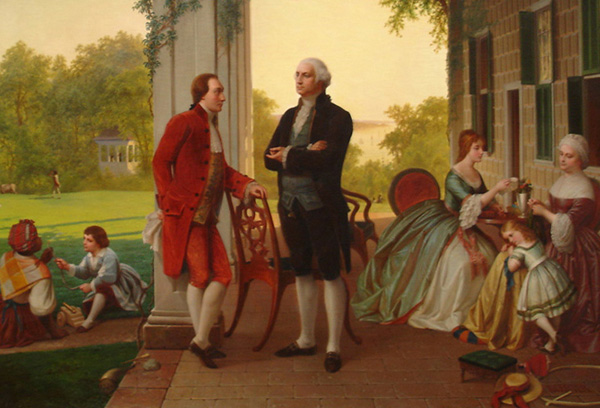
LaFayette and Washington: Two Great Men.

Please Donate to The Imaginative Conservative
I realize we’re all starting to think about the holidays, but the end of the year is coming up as well. In your end of the year giving, please consider donating to The Imaginative Conservative.
I can state with absolutely no hesitation that Winston Elliott III and Stephen M. Klugewicz throw their very selves into everything connected with the site. Indeed, the site itself now receives well over 250,000 reads a month. Given that The Imaginative Conservative is only 5 years old, this is astounding growth and readership.
Not only have they provided a solution to the need for serious discussion (NEVER dumbed down), but they also foster very civil discussion. And, in doing so, they’ve created a network of minds, hearts, and souls that values dignity, order, and freedom.
http://www.theimaginativeconservative.org/2013/12/help-us-the-imaginative-conservative.html
Russell Kirk on the Shift from Republic to Empire
An excellent speech, originally given at the Heritage Foundation.
http://www.heritage.org/research/lecture/political-errors-at-the-end-of-the-20th-century
Triumph of the Will? Bill O’Reilly & Snake-Oil Conservatism
Few things reveal the degraded state of “conservatism” in America more than the recent, seven-minute exchange between Bill O’Reilly and George Will. The post Triumph of the Will? Bill O’Reilly & Snake-Oil Conservatism appeared first on The Imaginative Conservative.
http://www.theimaginativeconservative.org/2015/11/triumph-of-the-will-soul-of-conservatism.html
Dr. Bob Stacey on Russell Kirk: American Conservative
The very first review of RUSSELL KIRK: AMERICAN CONSERVATIVE is up, and I couldn’t be happier. Thank you, Bob, and thank you, The Imaginative Conservative. A deep honor.
http://www.theimaginativeconservative.org/2015/11/review-of-russell-kirk-american-conservative.html
 Stormfields