
E.I. Watkin, “Poetry and Mysticism”
Few remember E.I. Watkins, but he once stood at the forefront of the Catholic Literary Revival. If he’s remembered today, it is as Christopher Dawson’s best friend.
Here’s an excellent piece from him. Enjoy.
Russell Kirk, “Property Healthy for Man” (THE FREEMAN, 1964)

One of the most evil works of collectivism — whether it be called communism, state capitalism, socialism, “people’s democracy,” or what you will — is the destruction of true private property. For the longing of man to have something genuinely his own goes back beyond the roots of civilization.
In the Nazi and communist concentration camps, the wretched prisoners clung, as their last hope, to some particular patch of floor in cell or barracks, where they could sleep every night and crouch during the day. The most extreme cruelty which their jailer could contrive was to shift their victims, frequently, from spot to spot or building, so that even this last show of private property was denied them. They had nothing to call their own.
As the bull, doomed in the ring, returns after every charge to his little patch of stamping ground, so man requires innately some tiny territory that is his. This point is made sagaciously by Mr. Robert Ardrey in his book, African Genesis: A Personal Investigation into the Animal Origins and Nature of Man.
In man, as in most other animals (not counting insects), Mr. Ardrey points out the instinct for status and one’s own domain is stronger even than the appetite for sex. It is this fact which Marxists and other utopian reformers ignore, to the great suffering of modern mankind.
“We, the approximate Class of 1930,” Mr. Ardrey writes, “today furnish trusted and vital leadership to world thought, world politics, world society, and to whatever may exist of world hope. But we do not know that the human drive to acquire possession is the simple expression of an animal instinct many hundreds of times older than the human race itself.” The rediscovery of this fact, Ardrey goes on to explain, refutes Marxism.
Nearly 90 years ago the great legal authority, Henry Maine, declared that civilization is the product of personal property. This thesis is reaffirmed in our time by Dr. Gottfried Dietze, in his slim, important book, In Defense of Property. If you deprive man of true property, you work for the destruction of culture and a just civil social order.
Human nature is constant. We moderns are not really different, in longing and character, from the ancient Egyptians whose hopes and lamentations we can read in their tombs. And if we deprive modern humanity of one of its natural satisfactions and supports, we reduce mankind to something less than it ought to be.
So it is necessarily evil to be rootless, to own nothing, to be simply a little insecure speck in a kind of tapioca pudding society. And the more personal a piece of property is, the healthier for man it becomes. Merely owning a stock certificate or a bond or a deposit book does not satisfy the instinct for property — though doubtless this is better than no property at all.
Thus the crofter in the Hebrides, or the Portuguese fisherman in his tiny cottage, in one considerable sense is a happier and truer man than the most successful industrial manager in Soviet Russia. He possesses his own little domain, while the industrial commissar is lost in an impersonal, propertyless, gray insect world.
–Russell Kirk, “Property Healthy for Man,” THE FREEMAN (September 1, 1964). For the link at FEE: http://fee.org/freeman/detail/property-healthy-for-man
University Bookman (Spring 1972), full issue
Great issue of the University Bookman. Featuring an article by Father James Schall and a review of Kirk’s book on T.S. Eliot.
Winston Elliott III on Ted Cruz
My great friend, Winston Elliott, is featured in a story on Ted Cruz. Nice.
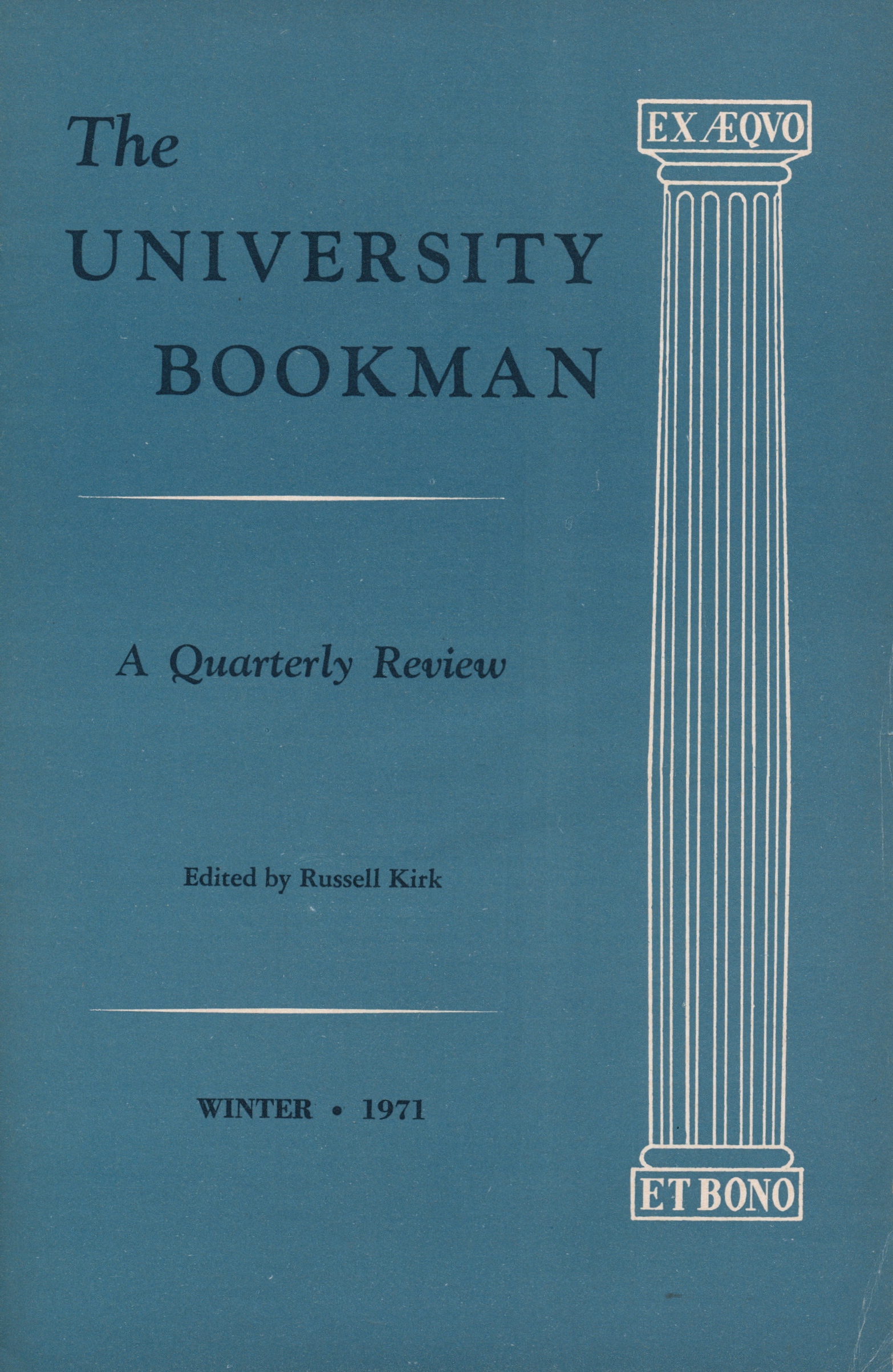
University Bookman (Autumn 1970), full issue
 Excellent issue from 1970. With pieces by Claes Ryn, Warren Fleischauer, and Wes McDonald.
High The Memory Carry On – a personal tribute to Chris Squire

There is nothing like the passing of a musical hero to put your own life and mortality into some greater perspective.
First, it was Freddie Mercury, whose passing on 24 November 1991 was not unexpected as I had received an early tip-off that he was HIV positive.
However, the suddenness of Chris Squire’s untimely death yesterday aged 67, just a month after the news was released that he had developed a rare form of leukaemia for which he was receiving treatment, is a shattering, unbearable blow. Again, this horrible disease has claimed another high profile victim.
At the moment, while still recoiling from this hideous news, I feel a huge hole has been torn out of my musical, cultural and spiritual fabric.
Apart from family and friends, musicians have always been my closest “allies” and with the demise of Chris Squire, it has suddenly become almost too personal.
Let…
View original post 1,559 more words
Steve Hogarth on Brilliance and Success

 Promo for Vol II of THE INVISIBLE MAN DIARIES.
“I’m reminded once again that it’s not enough to be brilliant. You need that lucky break that crosses you over to the mainstream punters. And a shed load of marketing money. . . It happened to Marillion before I met them and we’ve managed to maintain a hard-core big enough to make it possible for us to function at a certain level. It’s like getting an enormous rock to roll. Once it’s rolling you can keep it going easier than the effort it took to get it started. So rockn’rolls’s not such a bad name for it. But it could have been called ‘momentum’ instead. Doesn’t have the same ring about it though. . . (and anything derived from Latin is very unrock n’roll.)”
–Steve Hogarth, THE INVISIBLE MAN DIARIES, vol. II, pg. 129

