
One of the best things about teaching math is sharing all of the connections that exist between seemingly unrelated topics. Take, for example, the Golden Rectangle. Often described as the most visually “pleasing” quadrilateral, it is a rectangle whose length, l, and whose width, w, are in the the proportion $latex displaystyle frac{l}{w}=frac{l+w}{l}$ .
Here’s an example:
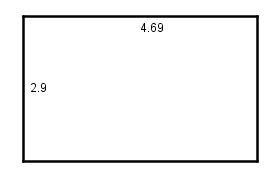 4.69 / 2.9 = 1.62, and (4.69 + 2.9) / 4.69 = 1.62. The number they equal, 1.62, is called the Golden Ratio, and it has its own Greek letter, phi. It’s actually irrational, like pi and e, and it equals $latex displaystyle frac{1+sqrt{5}}{2}$ . You can derive phi algebraically by solving $latex displaystyle frac{l}{w}=frac{l+w}{l}$ for l in terms of w. From the quadratic formula, $latex displaystyle l=left( frac{1+sqrt{5}}{2} right)w$, so $latex displaystyle frac{l}{w}=frac{1+sqrt{5}}{2}$.
A Golden Rectangle can be constructed with a straightedge and compass (or GeoGebra!):
1. Construct a square ABCD:
View original post 341 more words
 Stormfields